Revived productions can quickly age or feel like they’ve lost their initial shine, but for some, the passage of time and a revisit, as well as some fresh casting, can sharpen the focus and allow for less successful elements to be refined or even dropped. Annabel Arden’s production of Rossini’s Il barbiere di Siviglia is back at Glyndebourne once again, ten years after it debuted, and here, the latter definitely applies, in a production that seems to get better with each outing.

Rossini and his librettist Cesare Sterbini’s take on Beaumarchais’ original French comedy surpassed numerous other operatic versions, not least the previously most successful adaptation by Paisiello (who gets an in-joke name check in a fourth-wall breaking interaction between Figaro and the conductor). Its masterpiece surely rests in catchy tunes and many opportunities for singers to demonstrate dazzling coloratura and breakneck-speed articulation, but it is ultimately the pace of the comedy, never allowing too much time for us to question, for example, the nonsense of not one but two ‘disguises’ for the Count which somehow manage to fool Dr Bartolo (in this production amounting to not much more than hats which are quickly dispensed with anyway). And it is the focus on the comedy, along with bright and colourful design, without any attempts to make any deeper comment or add further meaning to the opera’s delightful champagne froth.


A few things have fallen by the wayside from Arden’s original – Bartolo’s in-joke on-stage Glyndebourne picnic, as well as an incongruous Elvis-style quiff for the Count went early on. The surreal antics of the trio of actors, at times with more than a whiff of Laurel and Hardy as they manhandle (for no clear reason) a harpsichord around the stage, have been trimmed, feeling less intrusive as a result. Revival director Angelo Smimmo has nevertheless retained the slightly random proliferation of harpsichords that descend from the sky in the confusion at the end of Act 1 – a not entirely convincing device, but harder to remove from the overall concept.
Joanna Parker’s design uses a backdrop of Moorish blue and white tiles, highlighted with a stylised geometric pattern, setting us in Spain, but the costumes are non-specific in terms of period, some but not all suggesting the 1950s. There’s lots of colour and interest (the cascading red flowers in the opening balcony scene, the blue tiling and the bright green uniforms of the police).
All the cast, including a few Glyndebourne debuts as well as a few returning to their roles, managed well the demands of Rossini’s rapid-fire patter. There were however a couple of places where in ensemble they came perilously close to running off the rails, not helped by having to shuffle left and right as a group whilst delivering the complex set pieces. They held on by their fingernails, all adding in a way to the slightly unhinged chaos of Act 1. It is also their collective comic skills that make this craziness work so well, with perfectly pitched acting from all.

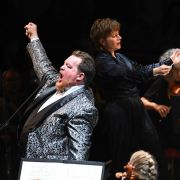
Lluís Calve I Pey’s Figaro was playful and full of confidence, emerging from the pit and appropriately popping up all over the stage. His “Largo al factotum” flew by without effort, his rich baritone smooth yet precisely articulated. Hongni Wu’s Rosina had warmth and heart, as well as great comedic timing, her smooth mezzo voice negotiating the coloratura with ease. Nico Darmanin’s Count Almaviva was suave and beguiling (sans quiff), with equally accomplished fast-paced comedy, and after initial lightness at the top of the range, his voice grew in presence.


Fabio Capitanucci as Bartolo was the most impressive of the gang with Rossini’s devilish patter, bringing more comedy but avoiding becoming too cartoonish. Cumhur Görgün managed Basilio’s general confusion well, also relishing his smoke trick, whilst delivering the role with clarity of tone. And Ailish Tynan enjoyed her turn as Berta, aided and abetted by performer Maxime Nourissat (also the revival Movement Director) in her showstopping Act 2 aria, and bringing strength and brightness to ensembles. Adam Marsden from the Glyndebourne Chorus revised his role as the Officer, notably the only veteran of the original 2016 production, bringing a sense of playful confusion, and leading his band of chorus soldiers with aplomb.

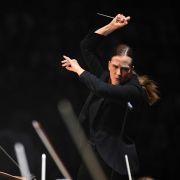
In her first lead conducting role at Glyndebourne, Chloe Rooke directed the Glyndebourne Sinfonia with tight ensemble throughout, holding her nerve in those tricky moments with the full cast, and the overture had the right amount of fizz to whet the audience’s appetite for what is a delightful production that will no doubt remain in the Glyndebourne portfolio for a while yet.