For their eighth outing, Gothic Opera have upped the rarity stakes. If you know of Fromental Halévy at all, it might be for La Juive, his only opera to have secured any position in the modern repertoire. Yet he was a big deal in the 19th century, with over 30 operas to his name, and performances running into the hundreds. Yet after his death, his popularity quickly waned. But this company wasn't content with just choosing a forgotten composer: they have gone for a forgotten opera too. His comic La Dame de pique has not been staged since its original 1850 performances, and so their production is almost certainly a UK premiere.

Loosely based on the Pushkin tale that Tchaikovsky would pick up on some 40 years later, with a libretto by Eugène Scribe, La Dame de pique is a complicated affair, with its tale of love thwarted by class and status, and the power of chance. There's also a supposed pact with the devil, a supernatural ring and three magic cards. It’s all rather daft, with the added novelty of a salt mine as a setting. Originally set in a Russian/Polish village in the reign of Peter III, just to complicate things further, director Jonny Danciger has shifted the action forward a few decades, and over to France on the brink of revolution.


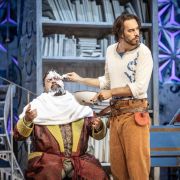
Danciger has also added adapted dialogue, delivered in English, while the opera is sung in French. This jars somewhat, particularly as the tone is also mixed, between relatively straight exposition and more updated comic language (‘Christ on a chaise longue’!). This also highlights an overall mismatch of stylistic tone within the production as a whole. Sam Utley’s Prince Zizianoff and Alistair Sutherland’s Klaremburg from their first entries emphasised the comedy throughout, giving another layer to Zizianoff’s ‘Let’s camp here’ line. Fair enough, but this verged on pantomime, rather undermining the more serious attempts to move us into revolutionary territory. Ultimately, this is an issue with Danciger’s shift – does comic opera really sit with the storming of the Bastille? We also lose the final revelation (albeit a very confusing one) that the masked woman at the end is not the Princess but a Countess instead. Instead there is a more serious tone to the revolutionary idea that ‘the rules can be changed’, running alongside ‘the dealer always wins’.

Visually, great use has been made of the Battersea Arts Centre Hall, its gothic bare walls adding a ready-made backdrop to the otherwise simple and effective staging, with colourful costumes, shifting from military to revolutionary. Grace O’Malley (Princess Polowska) had impressive stage presence, as well as fine coloratura, the most impressive vocally of the evening. Unfortunately, her big entrance was blocked on stage by the chorus on the raised staging for those in the front rows – a general staging issue with tiered seating down the floor in front of raised staging.
James Hutchings (Constantin) was engagingly bright, lightly secure at the top of his range, and convincing in his role as the troubled suitor, transposed from soldier to revolutionary. Sadly his big emotional aria at the top of Act 2 was obscured by noisy scene changing, which involved retiling the stage to reveal the mine. Alice Usher (Lisanka) gave an authoritative performance, with the lion’s share of exposition dialogue to deliver, and a clear bright tone. Charlie Epps (Roskaw) managed well his descent from confidence into desperate destitution, stronger at the top of his baritone range than when in the lower registers. Pantomime comedy aside, Utley and Sutherland both sang with commanding tone throughout, and HoWang Yuen was also convincing in the minor role of Sowbakin.


Once again, Leon Haxby has done a great job at reducing what must be a substantial orchestral score for a band of just seven players – strings plus oboe/cor anglais and percussion. Obviously orchestral colour was relatively limited as a result, but effective use was made of bells, glockenspiel and tambourine for effect, as well as the cor anglais to add deeper wind resonance. Conductor Hannah von Wiehler drove the production with clarity and energy, and with the band on the flat to the right of the stage, communication with singers was good, ensuring tight ensemble even in the more complex chorus moments. The small chorus of seven singers were impressively flexible, with presumably male miner choruses rescored to use upper voices, and they produced a powerful collective sound beyond their number.

Hats off to Gothic Opera for bringing this delightfully bonkers confection to our attention. There’s definitely merit in bringing Halévy back into the limelight, although I suspect if all his plots are as complex, simplicity might better highlight their assets.