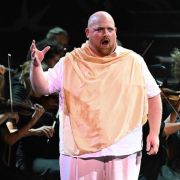
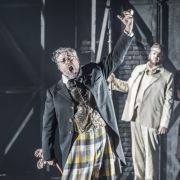
It requires discipline as a seasoned opera-goer to avoid familiarity with some of the operatic warhorses mutating to saturated fatigue. Any feelings of weariness with Rossini’s Il barbiere di Siviglia were dispelled by Grange Park Opera's new production, full of joy, humour and sheer sexiness.

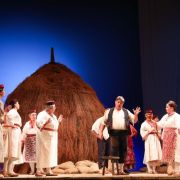
Director Bruno Ravella brings the setting forward to the early 1900s and in his Rosina, we have a figure straight out of the women’s emancipation movement, at odds with the stolid world of Doctor Bartolo and the starched clerics represented by Don Basilio. Francis O’Connor’s ingenious sets are attractive metal frames that twist and pivot, easily swinging from a street view to the interior of Bartolo’s residence, with a backdrop of pendulous orange globes – Seville oranges, presumably – giving something of a fairy-tale effect. The impact of the frames is to provide excellent sightlines and also a sense of space, but O’Connor fills the space elegantly – the skeleton of a piano, a solid desk and well appointed furniture all speak to a production that is being sensible, but not mean with its budget.


Ravella takes the humour at a lick, with Figaro singing “Largo al factotum” from his shower (surely a treat for the singer, given the weather), Rosina tearing around the stage and crack comic timing that stays the right side of cheesy. This is a production conceived and directed with joie de vivre at its heart, and executed by its cast with energy and merriment. Only in one or two minor places can flaws be detected: the band of musicians at the start of the opera, a collection of locals ranging from a butcher to medical practitioner, do not actually start ‘playing’ their instruments until quite some time after their tune beings; the end of Act 1, always a difficult one to pull off, feels silly without really being funny, and “Buona sera, mio Signore”, such an opportunity for comedy, was handled rather seriously. These are mere quibbles, to be set against a splendid broader offering.

Accompanying the high quality of the production was a universally excellent cast. First among equals, Ginger Costa-Jackson brought firecracker energy to Rosina; positively fizzing across the stage, smouldering at Almaviva and casting black looks at Bartolo. She showed off a smoky mezzo with well-integrated registers and a generosity to the higher register. “Una voce poco fa” had pinpoint coloratura, deployed with graceful agility. To her Almaviva, Nico Darmanin brought an appealing tenore di grazia to the role. His voice is soft, but has reach and a ping at its top, just right for bel canto repertoire. As Figaro, James Newby showed a robust baritone, with plenty of agility and shaded with mirth. Simon Bailey’s bass-baritone is innately mellifluous and gave a soft-voiced Bartolo, with excellent patter and a real focus on the text. Julian Close sang Don Basilio with a lugubrious bass and Ailish Tynan was absurdly good casting as Berta, her “'Il vecchiotto cerca moglie” capped with a high note as good as those of Costa-Jackson’s.


Completing the trifecta, conductor Gianluca Marcianò brought his characteristic energy to the Gascoigne Orchestra; an overture with plenty of thrust promised excellent things, but his big success was to bring total balance across the entire cast and the pit. Harmony reigned; Cupid smiled; the audience laughed regularly. Catch this show while you can.