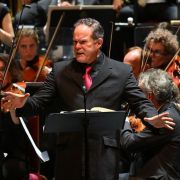
Why don’t we celebrate Joshua Bell more vociferously? Were the American violinist the latest thing we’d be stomping and cheering his every appearance. Perhaps his long spell with the Academy of St-Martin-in-the-Fields (15 years at the helm and counting) has made us take him for granted. More fool us if so, as this thrilling concert demonstrated.

The amuse-gueule was a ten-minute slice of sonic atmosphere by Bell’s fellow-countryman Kevin Puts, whose opera The Hours caused a stir across the pond three or four years ago. Earth was originally commissioned (by Bell) for a larger orchestra and, even in a reduction for Academy forces, it tasted like Copland-meets-Kancheli. The lush, verdant introduction, its comforting tonality cushioned by a rising four-note ground, gave way to a scuttling second section redolent of ants under a stone, before relaxing to a peaceful, muted close. Bell, absolutely committed, conducted from the violin – as he did for the big beast that followed.


In the Violin Concerto of Brahms, the ageless virtuoso (he still looks decades younger than his 58 years) avoided all trace of rhapsodic overkill but gave a performance that was sumptuously romantic for all that. One might carp at his first-movement cadenza – a top-heavy affair up to the point at which the composer notated it – but for the rest it was an impassioned testimony by both soloist and orchestra, blest with a divine oboe solo from John Roberts in the Adagio, while a Finale of unbridled panache proved, if proof were needed, that the 23 ASMF strings can sound perfectly massive when the devil drives.

Bell’s account of Schumann’s Spring Symphony (no. 1) was as sunny an interpretation as you’re likely to hear. Directing this time from the concertmaster’s chair (he chose a piano stool in order to free up his calisthenics) the hyperactive leader delivered a reading of energy and fluency. Featherlight where others lumber (try Harnoncourt for evidence of the latter!), the first movement sounded almost Schubertian in its youthful élan.


Bell’s excitable contortions as he guided his players caused the stool to slip and slide beneath him; yet somehow, thanks to glutes and willpower, he managed to cling on. The middle movements were calmer yet still exuberant, while in playing marked by joyous musicianship in the tuttis the entire symphony sang. And the finale danced.