Finding a mate for Bluebeard’s Castle is always a problem. Such a unique work has no natural bedfellow, yet left alone the one-hour duration amounts to a meagre night out. In 2021, Opéra de Lyon addressed this by presenting two different stagings of Bartók’s opera on the same evening. That, though, was a novelty rather than a solution. Welsh National Opera’s solution, a blind date with Stravinsky’s Oedipus Rex, is a shrewd one, for the ill-assorted pair shine like good deeds in a murky world of moral ambiguity.

There are problems with the production by Joe Hill-Gibbins, about which more anon, but musically these were thrilling performances only slightly undermined by the mannerisms of a narrator, LJ Parkinson, whose whimsical delivery (in English) scotched the dignity and tragedy inherent in both scores.


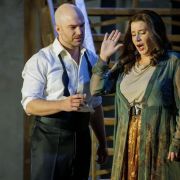
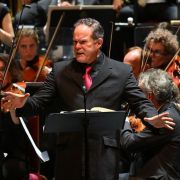
This account of Bartók’s only opera first appeared in English National Opera’s 2024 season, one of an annual series of lightly-staged productions that in other seasons featured Britten’s Albert Herring and Puccini’s Suor Angelica. It has transferred well to Cardiff and features committed and profoundly musical performances by Nathan Berg and Christine Rice as the forbidding Bluebeard and his inquisitive new wife Judith. As in London, it was conducted with tension and rigour by Lidiya Yankovskaya.

In Bluebeard, one can only regret that the power of her orchestral rhetoric is not reflected in some threadbare stagecraft set along a white dinner table during the aftermath of the couple’s wedding. Blood is represented by spilt wine, instruments of torture by armfuls of cutlery, untold riches by gold confetti. As for the seven doors and their keys, these are vouchsafed to the mind’s eye and in a visual experience that is not enough. As WNO’s blazing orchestra plays the living hell out of Bartók’s score, the ears hear inferno but the eyes see party popper.

The director’s Oedipus Rex, although new, is cut of similar cloth. Stravinsky’s librettist for this ‘opera-oratorio’ (his own description) was Jean Cocteau, whose fascination with the Oedipus myth had previously led him to write a remarkable stage play on the subject, The Infernal Machine.


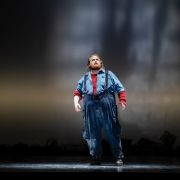
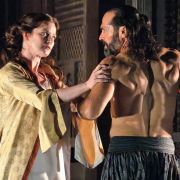
Hill-Gibbins grasps the hieratic nature of the piece and stages it with ideal simplicity on and around a zigzag of blood-red tabletops. The men of the WNO Chorus, singing in Latin, are marshalled into a swarming crowd that gazes implacably upon Peter Hoare’s Oedipus as he plays out his doom. This Greek chorus wears black to indicate its role as a representative figure rather than characters in their own right; meanwhile Christine Rice (Jocasta) and Nathan Berg (Tiresias) return, along with Stephen Richardson as both Creon and the Messenger, to enact the drama.

If you see this Oedipus Rex you may need to brush up on your Latin. The surtitles, dimly projected during both operas, are completely obliterated in the Stravinsky for swathes of the audience by the light thrown from a vast ceiling lamp just beneath them. This is a major irritant, the more so because the staging as a whole contrives to subjugate the tale of a fateful screw being turned. However commanding the singers' interpretations (and they are), however powerful the work itself both as melodrama and tragedy, Hill-Gibbins offers an unyielding experience.