Rossini’s opera La Cenerentola (Cinderalla) is perhaps his most under-appreciated work. Il barbiere di Siviglia is justly celebrated as a comic masterpiece and far more frequently performed, but the former work has an enduring charm and inventive score which create a believably non-magical (in the fairytale sense) world which, in the right hands, constantly delights. Rossini is at pains to emphasise the human dimension of the story – the good-hearted heroine being recognised for her virtue by the handsome prince – but he does not downplay the cruelty of stepfather and sisters (no stepmother in this version), which makes Angelina’s final forgiveness the more remarkable. This production from Opera Queensland does justice to its source.

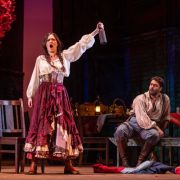
The QPAC (Queensland Performing Arts Centre) Concert Hall lacks a proscenium stage, drop curtains and so on, but director Laura Hansford, deals with that with a fluid and effective staging. Taking its cue from a line in the Act I finale – “I seem to be in a dream among groves and gardens”, visual floral motifs and the colour pink dominates the set and costumes. The set features a pink curtain backdrop, with a prominent screen for the English surtitles nestles in a bouquet surround. A small number of props – a stove for Cenerentola to huddle next to, chairs, a sofa – are tidily placed and removed by the well-drilled male chorus. Just to pick one small nit, it was a bit of a worry to see red wine coming out of a white wine bottle. And speaking of wine, there were audible shudders from the audience at a certain wine recycling scene.


Similarly with the costumes. The stepsisters appear first in tight bright pink dresses and big hair, and for the ball exaggerated gowns with masses of roses. Don Magnifico mostly appears in a black suit embellished with huge red flowers, and a massive collar of roses for his evening wear. The more tasteful suits of the other men features green foliage decoration. Alidoro lives up to his name (“wings of gold”) when enveloped in a voluminous gold cape, and Dandini wears a dashing white suit with gold foliage when masquerading as the prince.
The Queensland Symphony Orchestra conducted by Richard Mills, got off to a slow start, while some introductory comments in English scrolled across the scene (“Once upon a time …”), accelerating into a speedy Allegro for a typical crescendo as the stage was set. The men of the Opera Queensland Chorus not only served as kabuki-style assistants, but sang with excellent discipline and sonority.

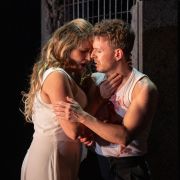
Angelina/Cenerentola was sung by Margarita Gritskova, who is no stranger to the role. Her rich deep mezzo is allied to an excellent technique, with stunningly held low notes, and her personification of the role was affecting. “Nacqui all’affanno... Non più mesta” was the highlight it should be, with effortless coloratura. She was partnered with Turkish tenor Mert Süngü as Don Ramiro, as equally at home as Gritskova in bel canto repertoire. His squillo tones were heard to advantage, but Dandini’s undressing during “Sì, ritrovarla io guiro” was a bit of a distraction. The two principals evinced a convincing mutual coup de foudre when their eyes first met, and the audience cheered when they finally embraced.
Bass-baritone Jeremy Kleeman was an entertaining Dandini, nimble of voice and body with resonant bronze tone, relishing his role as the pretend prince and tossing back popcorn at the imbroglio before the final resolution. Alidoro was sung with calm authority by local baritone Shaun Brown.


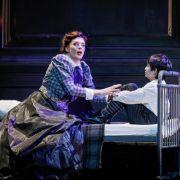
The trio of self-serving stepfather and sisters were well portrayed by James Roser (Don Magnifico), Sarah Crane (Clorinda) and Hayley Sugars (Tisbe). While the latter are depicted as very silly girls, Don Magnifico is a bit more than silly, and the audience seemed to enjoy his comeuppance. Roser’s performance was convincing in his self-importance, and the rather inane cavatina about his dream of a winged donkey (“Miei rampolli femminini”) was well delivered. As with most of Rossini’s operas however, this is not just a showcase for florid solo singing, but one in which ensembles of all kinds are important. On that score, all contributed well, with excellent performances of the Act 1 quintet (“Non volto estatico”) and the Act 2 sextet (“Questo è un nodo”) and all the other permutations. Overall this production captures all the humour – maybe a tiny bit more than needed – and the humanity of the work without any sacrifice of musical values.