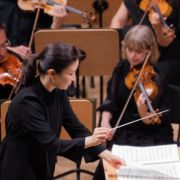
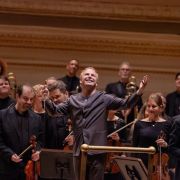
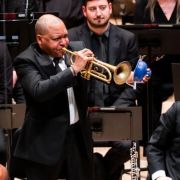
The two new pieces were the highlights of “New Beginnings”, Jonathon Heyward and the Festival Orchestra of Lincoln Center’s final offering this season. Anchored by Robert Schumann’s Symphony no. 1 “Spring”, it also included an opener by Frederick Delius, a world premiere by Hannah Ishizaki and a New York premiere by Billy Childs. Both of those latter pieces were striking, engaging and masterfully performed.

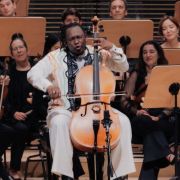
Childs’ A More Perfect Union is a double concerto for flute and clarinet, played respectively by brothers Demarre and Anthony McGill. One of many works commemorating the United States’ 250th birthday this year, the title of the first movement, I, too, sing America, taken from a poem by Langston Hughes, gives notice that this commemoration will be seen through the lens of the African-American experience, a context that informs the second movement, Family, and the third, A Call to Action. It’s an expertly orchestrated, beautifully dynamic work, inhabiting a lot of the same territory as film music but without ever straying into cliché.


It’s easy to hear the two solo parts as protagonists in a narrative, as they sometimes intertwine, sometimes alternate. They more often lead the orchestra than soar over it; until the twin cadenzas in the final movement, there’s little that’s overtly virtuosic. Aside from the architecturally ambiguous passage that separates those cadenzas, though, there’s a clear path from the energetic community of the first movement, through the solace and sorrow of family in the second, to the emergency of the third. The ending passage, in which the soloists took foreground with orchestral punctuation, evoked the triumphant empowerment of the protagonists.

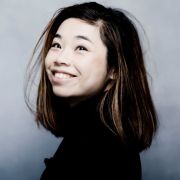
Ishizaki’s Change Thy Course was commissioned for this concert and takes as its inspiration materials from both the Schumann symphony and the poem on which it is based. While the Schumann materials are more Easter eggs for music theorists than anything audible, the piece itself, in a much more modernist idiom that the Childs, is inventive, sonically appealing and structurally satisfying. Memorable moments include bendy woodwind solos over a panoply of sound effects, including buzzes, whistles and improbably loud wind noises; a hi-hat cymbal obbligato over a bed of chaotic string activity; and an extended klangfarbenmelodie stopped in its tracks by a single ringing vibraphone note.


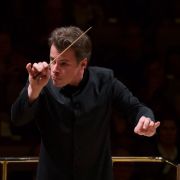
Heyward does this kind of thing extremely well. In neither of those pieces was there ever a sense that there was a detail unexamined, an opportunity for expression not realized. I wish I could say the same about the older pieces on this concert. Delius’ On hearing the first cuckoo in spring from Two Pieces for Small Orchestra is a repetitive, monochromatic piece, perhaps meant to evoke a cloudy, cold day at the very beginning of the season. The cuckoo sounds depressed. If there’s a case to be made for the piece, Heyward did not make it.
The Schumann was competent but very much by the numbers. I kept waiting for Heyward to make an interpretive choice. Aside from the unfortunate one of taking the initial tempo of the Scherzo much slower than the score’s metronome marking, there were few to be found. Tempo shifts were timid; articulations were dutiful; at moments of maximum tension Heyward seemed to be trying to show that pauses, unlike people, can in fact be only a little bit pregnant.