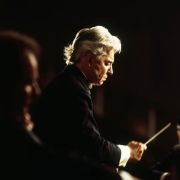
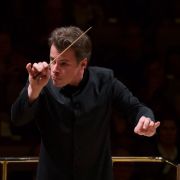
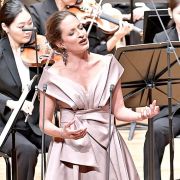
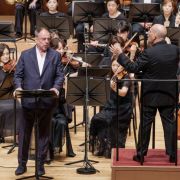
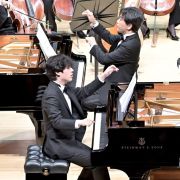
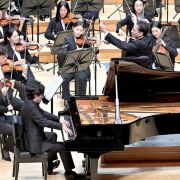
At Seoul Arts Center, María Dueñas made her Korean debut in Brahms’ Violin Concerto in D major, joining Gustavo Gimeno and the Luxembourg Philharmonic on their return to Korea after three years. Her Brahms could sound abrasive, but its lyrical conviction proved difficult to resist.

Her first solo entry sounded unsettled. Strong accents gave her tone a coarse edge without much increase in volume, and orchestral responses sometimes seemed to wait for her phrases to finish. The resulting separation weakened the concerto’s conversational charge. In the development, too, the partnership needed sharper mutual provocation; Gimeno gave her room, but the orchestral contribution did not always make that freedom productive.


Dueñas’ lyrical phrasing supplied the stronger argument. Over the pizzicato accompaniment, the second subject moved with a supple, unbroken sense of destination; in the recapitulation, it acquired a more withdrawn colour and a deeper ache. Her modest sound began to feel sufficient because the melody carried the ear so naturally from one inflection to the next. Her phrasing had a vanishing point. Even in hesitation, one sensed the distance ahead.
Her own cadenza extended this power of recollection. Themes changed register and harmonic emphasis, acquiring emotional consequence through their new surroundings. The double-stops gathered into rich chordal sonority at the expense of distinct lower voices, but the passage maintained a convincing train of thought. Its quiet deliberation made the orchestra’s re-entry feel inevitable, and the subsequent recovery of momentum restored the movement’s public scale.
The Adagio allowed that lyrical gift to speak with particular directness. Dueñas took the oboe’s melody into a continuous, finely inflected cantabile, keeping embellishment within the breath of the phrase. The reprise had an affecting composure: tenderness sustained through the line, with little need for expressive underlining.

In the finale, the earlier containment turned into exuberance. Dueñas gave the refrain’s double-stops a firm, dancing tread and the central dolce episode room to sing. The refrain’s later return brought renewed elasticity. Her passagework kept its definition as the closing acceleration tightened its grip. This release belonged to the whole interpretation. The opening’s force and the inward song had found a common destination.


Gimeno’s Dvořák Seventh Symphony after the interval was measured and clearly proportioned. The lower strings articulated the opening theme cleanly, but the orchestral bass needed greater weight. Lyrical passages had space to expand, and the first movement’s retreat into quiet retained its tension. The Adagio’s later climax had real gravity, although the surrounding lyricism could feel emotionally undernourished. The finale gathered its successive surges with purpose, its closing D major broad and unsmiling.
What remained uneven was the orchestra’s responsiveness within that plan. The Adagio’s woodwind and horn solos were warmly shaped, yet the accompaniment could seem impatient with their breathing. In the Scherzo, emphatic attacks lost some spring through untidy releases; the finale’s brass occasionally covered the inner movement of the strings. Too often, a convincing arrival had to compensate for an ungenerous transition. One respected the symphony’s organisation without being consistently drawn into its life.
This concert was promoted by Vincero.