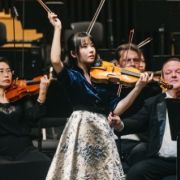
Piano concertos by Singaporean composers can be counted on one hand. At last count, there were three by Kelly Tang (born 1961) and one each by ex-Nadia Boulanger student Leong Yoon Pin (1931-2011) and Bernard Tan (born 1943), all venerated veterans. Thus, the world premiere of a new concerto by a young composer, represented by the highly eclectic Jonathan Shin (born 1992), becomes all the more significant.

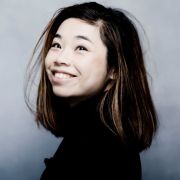
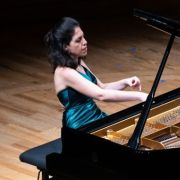
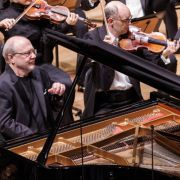
Commissioned by the Singapore Symphony Orchestra and titled Child of the Shore, Shin brought a Singapore perspective without having to quote local melodies or display Asian influences. Written to showcase the flamboyant pianism of soloist Churen Li, its exuberant solo worked the keyboard’s upper registers overtime. The opening movement, Gerygone, recalling the song of the golden-bellied gerygone (a denizen of Southeast Asian rainforests) in its light and scintillating writing. Incorporating mild dissonance but never atonal, this piquant mix of lyricism and brilliance relived the spirit of piano concertos by Michael Tippett (1955) and the Australian Carl Vine (1997).


As she looks out to sea, the central slow movement, now quoting from the novel The Great Reclamation by local writer Rachel Heng, referenced Xinyao (songs sung in Mandarin from 1980s popular culture) and was unafraid of being sentimental. At moments, the music almost seemed to lapse into Singaporean musical theatre composer Dick Lee’s hit song Bunga Sayang but resisted the temptation. Li’s busy solo opened the jazzy finale, Peripheral Joys, which recounted the exhilaration of a morning commute (presumably without tube services breaking down!), went full toccata mode before closing in unfettered joie de vivre. Shin has written the quintessentially Singaporean piano concerto which loves and celebrates life. A repeat performance cannot come soon enough. Li’s own jazz-inflected improvisation on Dick Lee’s Home (almost a second national anthem) as encore put the icing on the cake.
The balance of the concert was Russian, with Mikhail Glinka’s Valse-fantasie being the curtain-raiser. Far away from wearing his nationalist hat, the music celebrated Central Europe, and looked ahead to the ballets of Tchaikovsky, Glazunov and Shostakovich.

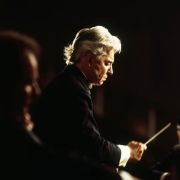
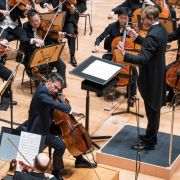
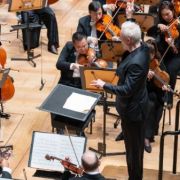
Shostakovich’s bitter Symphony no. 10 in E minor occupied the second half. Composed after the Great Patriotic War and still in the midst of totalitarian terror, it was premiered until after Stalin’s death. In a short preamble, SSO music director Hans Graf eloquently elucidated its main themes. Even in the darkest recesses of its murky opening, there was a ringing clarity that was to permeate the entire performance. The chaotic development and the second movement’s relentless portrait of sheer malevolence could not have been trenchantly voiced. As if with a flick of a switch, the composer’s personality and his coded messages (D-S-C-H and E-A-E-D-A, the latter representing his one-time pupil Elmira Nazirova) took over the last two anarchic movements. Closing with barely disguised mirth, Shostakovich had proclaimed “the monster is dead”, and it was time for the self-actualised artist to come to the fore.


The SSO has lived with this masterpiece since 1982, and was the main subject of its tenth anniversary recording conducted by its first Music Director Choo Hoey. The orchestra has progressed immeasurably besides coming a full circle. This review is dedicated to the memory of Choo Hoey (1934-2025), whose contribution to classical music in Singapore can never be over-emphasised.