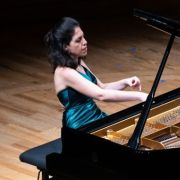
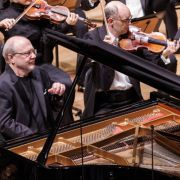
In 2022, Russian pianist Anna Geniushene was awarded the Silver Medal at the 16th Van Cliburn International Piano Competition, second only to the prodigious 18-year-old Korean Yunchan Lim, who attained overnight viral fame. Geniushene was 31 at the time and already a mature artist. Having heard both pianists in concert, one senses that Lim is still finding himself in the inevitable slew of concert and recording engagements, while Geniushene – with a steady career – already knows exactly what she is all about.

Her second Singapore recital was centred on early opuses and less-programmed pieces by Chopin and Brahms. Opening with Chopin’s Rondo in C minor, Op.1, the work of a 14-year-old, all the musical influences were on display – Mozart’s humour, Weber’s filigree and a love for bel canto. Its second subject in E major was where Geniushene stood out, with her phrasing and singing lines, amid the requisite prestidigitation and calisthenics. This was not some exercise to be whipped off in a showy display, but something far deeper.


Moving to mature Chopin, the three Op.50 Mazurkas showed keen identification with the Polish dance idiom, with generous helpings of rubato along the way. The three Waltzes from Op.34 carry the adjective brillante, but this applied to the first and third dances, delivered with ebullience and vertiginous flourish. That left the central A minor, taken at a glacial pace as to induce somnolence and strain credulity. These extremes in dynamics carried into Ballade no. 2 in F major, where gentle sicilienne rhythm meets headlong with violence. These stark contrasts made the tumultuous coda all the more exciting. The Tarantella in A flat major closed the first half with rumbling athleticism, without the twinkle-toe lightness or inner voices of Claudio Arrau or Shura Cherkassky.
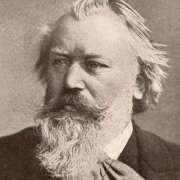
Geniushene was even more convincing in the music of Brahms. Jokes and punchlines of the early Scherzo in E flat minor, Op.4, were delivered with much immediacy, manifested in abrupt and clipped phrases, answered by hectoring octaves of authority. To assuage the final deluge of notes to come, Alfred Cortot’s tender transcription of the familiar Wiegenlied was most lovingly delivered.
Brahms’ Piano Sonata no.1 in C major was the ambitious outpourings of a 20-year-old. Its opening salvoes of big chords recall Beethoven’s Hammerklavier and Schubert’s Wanderer Fantasy. Geniushene has the heft, mental endurance and innate musicality to do justice to this overwrought music, and scarcely missing a note while at it. The slow song-like second movement, most sensitively voiced, provided much-needed respite before the unrelenting onslaught of the final two movements. The tempo was upped to terminal velocity and volume, a wonder how an instrument could withstand such pummelling. Victoria Concert Hall’s Steinway D more than did so, and it was in its direction that Geniushene gave her first bow, before acknowledging audience applause.


Her encore of Leonid Desyatnikov’s silky Waltz in Honour of Charles Dickens was class and sophistication, while Shostakovich’s Polka from The Age of Gold, pure farce. She referenced an ongoing football tournament, held in a crooked capitalist state with corrupt and cowardly politicians. Sounds familiar, anybody?
This concert was promoted by Altenburg Arts