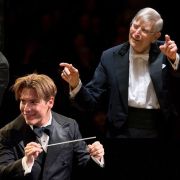
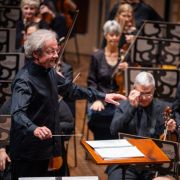
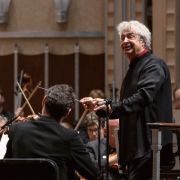
Over the past few weeks, Chicago Symphony audience members and musicians alike have had a chance to get better acquainted with their incoming Music Director, Klaus Mäkelä. The final program of his autumn residency spanned short pieces for brass, a Stravinsky ballet and an expansive cantata by William Walton. This program seemed calibrated to showcase the CSO's dazzling range of orchestral colors, with Mäkelä giving the ensemble ample opportunity to display its iridescent plumage.

The major works from Stravinsky and Walton were each prefaced with a fanfare by 16th-century Venetian Giovanni Gabrieli. While somewhat out of place, an opportunity to laser in on the CSO brass was nonetheless welcome. Cast in arrangements for modern instruments, various combinations of trumpets and trombones were split into two choirs of four. Gleaming and bright, it was hard not to have a visceral reaction as the brass pealed through the hall.


Stravinsky’s Petrushka opened in shimmering orchestral brilliance. The spark between Mäkelä and the CSO was electric, bursting with an athleticism that propelled the music forward. Its labyrinthine complexities snapped into place with rhythmic precision, yet a certain wit and humor ensured matters never felt purely mechanical. The CSO delivered in spades the virtuosity the score demanded; among the standouts were the limpid flute of Patrick Williams (guesting from the Philadelphia Orchestra), the trumpet acrobatics of Esteban Batallán, and the arresting percussive transitions between scenes.

The Russian Dance was particularly ebullient and the spiky dissonances which made up the iconic ‘Petrushka chord’ were given with ferocity. But it was the prismatic apotheosis that made the strongest impression, where the music’s zealous energy scattered into a kaleidoscopic array of colors, only to find its way to a flippant anticlimax.
A rarity closed out the evening in William Walton’s extravagant Belshazzar’s Feast, which in addition to the expanded orchestral forces, called upon baritone Thomas Hampson and the Chicago Symphony Chorus under the direction of Donald Palumbo. It’s a work that hasn’t appeared on a CSO program in over half a century, making Mäkelä’s revival a nod to former music directors Rafael Kubelik and Sir Georg Solti, both of whom championed and recorded it.


Powerful trombones opened to introduce the declamatory chorus, an imposing force throughout. It was clear from the beginning that this was not going to be music of subtlety. Hampson was a commanding presence and gave the text (assembled from Bible verses and original material by Osbert Sitwell) piercing clarity. One could only luxuriate in the music’s rich tapestry wherein disparate elements of instrumentation and style were seamlessly woven together.
Broadly conceived in three sections, the central part was particularly untamed with its striking descending gesture setting in motion a sonic feast meant to overwhelm. Brass fanfares – perhaps distant descendants of the Gabrieli pieces – gave it an inimitable English feel, and by the close, strife became joy and one could hardly imagine more exuberant writing. As the volume ramped up, blasts from the organ joined the fold in an almost comically overblown finale. It was a remarkably assured showing from Mäkelä, who seems intent on exploring every corner of the CSO's formidable sonic palette.