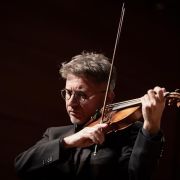
Much like exhibitions of rare sea creatures or fossils, some scores will introduce the music lover to uncommon, fascinating species of instruments – from the more familiar Wagner tuba to instruments that you might find in a clickbait Instagram reel about the ‘biggest double bass ever built.’ In a way, the basset clarinet falls into this category. Custom-made by manufacturer Theodor Lotz and clarinetist Anton Stadler in the second half of the 18th century, the instrument had a relatively short life, mostly dependent on Stadler’s own activity as a musician. Nowadays, the basset clarinet has resurfaced in historically informed performances of Mozart’s later works. In this capacity it was included in Jordi Savall and Le Concert des Nations’s latest stop at the Berlin Philharmonie. Their all-Mozart programme consisted of the Clarinet Concerto, with the ensemble’s own Francesco Spendolini as the soloist, and the Requiem in D minor.


In addition to its extended low register, Spendolini’s basset clarinet has a characteristically warm, clearly woody sound. The many virtuoso passages in the score – fast scales and arpeggios, leaps between registers – were tackled with clean phrasing and precision, yet retained a fogginess that standard clarinets don’t usually possess. Rather than an issue, this made for a pleasant feature of Spendolini’s interpretation. The smooth, misty playing, most evident in sections like the Alberti bass in the first movement, went well with the ensemble’s timbral profile. Contrasts between a resonant low register and a soft-spoken high register made the performance naturally theatrical, and Spendolini might have indeed convinced the most adverse to period performances thanks to his keen sense of lyricism.
Savall accommodated Spendolini’s playing with his usual receptiveness. Years of playing together have cultivated a great synergy in Le Concert des Nations, apparent in the way that both Savall and Spendolini interacted with the other musicians. Tempi on the slower side, especially in the second movement, risked testing the ensemble’s endurance but instead resulted in a successful experiment. A similar aplomb continued into the last movement, whose peppy 6/8 turned into an intimate, relaxed finale.
Things changed after the break, when Spendolini re-entered the ranks of the orchestra. Savalli’s recording of the Requiem with Le Concerts des Nations is easily retrievable, but I recommend taking the chance to listen to them live, if only out of love for a good dramatic interpretation. Right from the Introitus, Savall set brisk tempi, creating a sense of anticipation with the pressing staccatos of the accompaniment. The performance quickly took up volume, and by the time the Kyrie began, both conductor and orchestra seemed fully in charge of the overarching architecture of the Mass.


Among the highlights of the strings’ section, particularly precious were the Recordare, with its melange of cellos and basset horns, and the Agnus Dei, traversed by scales in the violins. As for the Capella Nacional de Catalunya, the choice to divide sopranos and altos from tenors and basses, rather than placing them together behind the orchestra, allowed for some interesting call-and-response moments and amplified the score’s homophonic sections.
Finally, the quartet of soloists turned out to be greater than the sum of its parts. While pleasant, Lina Johnson’s soprano remained somewhat understated, leaving a rather lukewarm impression. Tenor Kieran Cannel didn’t lack volume but could have used some more nuance in phrasing. Eva Zaïcik and Manuel Walser sang their parts convincingly. Fortunately, the four were at their best when they all joined together in the tapestry of voices.