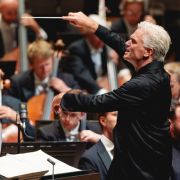
Roberto Gerhard’s one-movement Symphony no. 3 “Collages” depicts a dawn-to-dusk journey, each of its seven sections corresponding to a period of the day, using both orchestral and electronic sounds. Its elusive motivic and harmonic rapid shifts made it hard to follow any sense of symphonic form, so it sounded formless, playing for 20 minutes and then just stopping, rather than arriving somewhere. From 1960, so very much of its era, when modernism often meant loud aggressive sections dominate, a lot of added percussion (five extra percussionists) and frequent clangorous climaxes, exciting or rebarbative depending on taste. Sir Simon Rattle is a champion of the work but I wondered if it merited this rare outing with the London Symphony Orchestra.


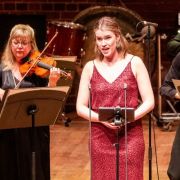
Only a dozen years earlier Romanticism in music had passed away, with the glorious Four Last Songs of Richard Strauss, the composer’s final work. A valedictory tone unites the songs, which were grouped together and given their title by Strauss’ publisher after the composer’s death. Lucy Crowe’s soprano suited them well, her singing as sparkling as her full length white and silver gown. Strauss’ soaring vocal lines are challenging, but Crowe started well enough, then improved with each song, though at times we might have heard more text. The final song, Im Abendrot (At Dusk) opens with a glorious orchestral surge, prefacing a subdued vocal entry. Soon that vocal line ascends, embellished by extensive melismatic writing, when Crowe also soared into that realm of vocal splendour. What a song, and what singing, and – never to be forgotten with Strauss – what orchestral invention. Rattle and the LSO relished it all, Leader Benjamin Gilmore and Principal Horn Timothy Jones expert in their solos, and well-deserving of their solo calls at the close.
But that was not the final song of the concert, for Mahler’s Fourth Symphony closes with a song called “The Heavenly Life”, giving us a child’s view of heaven. In another sense Mahler’s Fourth begins with that song, for he composed it for his Third Symphony, then removed it and made it the musical starting point for his next, preceding it by three orchestral movements. The opening is marked Bedächtig. Nich eilen (Deliberate. Not hurried). And in case the conductor missed the point he adds Recht gemächlich (Very leisurely).


Rattle nonetheless set off at a swift tempo and brought the movement in at 14 minutes. Yet, this being Rattle in Mahler, it was musical and persuasive on its own terms, and the beguiling second subject for cellos was ideal in its languorous and affectionate manner. As the Scherzo’s ‘village fiddler’, Gilmore scraped away with the best (or worst) of them on his higher-tuned instrument, although a muddle ensued via a broken string on one of violins soon after, all part of the rustic characterisation, perhaps. The loveliest of all Mahler’s slow movements then beguiled us, the climax with six horns, bells held high aloft, a splendid sight and sound. Mahler regretted omitting trombones from his score, for the only time in all his symphonies, but mainly at this climax. They were not missed, and I have never known a conductor, Mahler included, to add them. Crowe returned for the finale, now sparkling in green. Her diction was clearer, but the difference was less here than between Strauss’s and Mahler’s vocal writing and the degree to which they wished the text to be heard – and Mahler’s song is the fons et origo of the whole work.