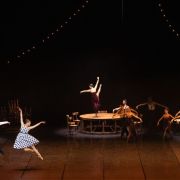
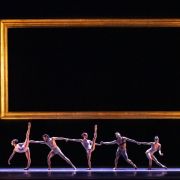
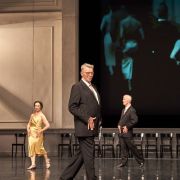
With an increasingly strong presence on the international dance scene, the Teatro Massimo di Palermo’s ballet company closes the current season with the ‘ballet of ballets’ – The Sleeping Beauty, presented in the innovative production created for the Salzburger Landestheater in 2024. The choreography is by Reginaldo Oliveira, director of the ballet company and principal choreographer in Salzburg, who brings his own vision of Charles Perrault’s celebrated fairy tale to Sicily, radically redefining the traits of the characters that have remained etched in the memory of the most nostalgic balletomanes.

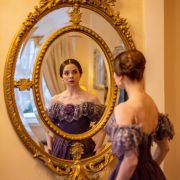
This vision is particularly evident in the dramaturgical construction of the production, as the young Princess Aurora is portrayed with a sense of awareness and determination far removed from tradition, taking on a decisive role in Prince Désiré’s plausible emotional redemption. The same impulse towards a rewriting of the canonical model extends to the musical dimension, through incisive interventions on the score, making for a more streamlined rendition of the ballet as a whole, although not every passage proves perfectly aligned with the choreography on stage. If, in the first act, the comic gags in the lengthy sequence devoted to the fairies’ celebrations for the birth of the princess prove only partially effective, Carabosse’s interventions are far more convincing, with Linda Messina taking on a key role in the narrative as conceived here.


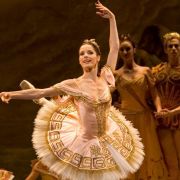
It is, however, in the choreographic language that the distance from tradition becomes most evident, through an approach that reveals interesting potential – as in the first-act waltz – while eschewing the customary solemnity and eloquence in favour of a reduced ensemble suited to a deliberately minimalist conception. The arrival of the five flamboyantly vain suitors is hilarious, followed by a Rose Adagio in which the protagonist’s dancing unfolds largely through pulling gestures and repeated swaying movements.

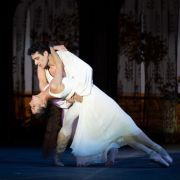
In the second act, the choreographer’s most original idea comes into sharper focus: placing the Prince among the inhabitants of a futuristic, frenetic metropolis in which there is little room for emotional impulse. Only his encounter with Aurora allows Désiré to imagine a future of rebirth and hope, through a solid pas de deux with a convincing choreographic structure, entrusted here to two highly accomplished dancers from the Sicilian company, Martina Pasinotti and Michele Morelli. Yet in this production, that redemption never fully materialises, as, upon the final awakening, the metropolis evoked here returns to its customary, gloomy ways. The same perspective is coherently reflected in the production design: the visual world conceived by Matthias Kronfuss for the sets and by Judith Adam for the costumes is, indeed, decidedly sombre.

Ultimately, the production engages with the great classic through a deliberate and radical rewriting: a choice that may appeal to those who seek new interpretative possibilities within the repertoire. Yet it is precisely the distance from the nineteenth-century model that makes the choice to retain the traditional title seem perhaps less appropriate. The distinctive, contemporary and visionary aesthetic adopted in this production would probably have been better served by a different title, one more closely aligned with this reimagining of Tchaikovsky’s ballet. Such an encounter with a different artistic vision nevertheless remains valuable for the Teatro Massimo’s ballet company, directed by Jean-Sébastien Colau, giving it the opportunity to engage with different artistic languages and perspectives and, through such projects, to further its artistic growth and deepen its engagement with the international dance scene.


Vito’s trip was sponsored by Teatro Massimo, Palermo