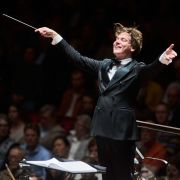
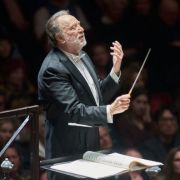
If the task were to describe in a single word the concert presented by the Royal Concertgebouw Orchestra last week, “exuberant” may well be the best choice. Marked above all by the energy and high level of engagement from soloist Seong-Jin Cho, conductor Dima Slobodeniouk and the orchestra, the evening produced charged readings of works whose particular demands call for both energy and insight.

Tchaikovsky's First Piano Concerto, one of the most iconic works in the Romantic repertoire, impresses less through its architectural conception than through its sheer abundance of virtuosity and lyricism. To meet those demands, the star soloist drew on a wide range of touch, adjusting his sound to the character of the music in front of him. The opening sounded impassioned, with robust, sonorous chords in which the great melodic arc was never lost. In the dotted-rhythm passages, by contrast, his approach was incisive and gritty, with a forcefulness radically opposed to the graceful lightness he reserved for Tchaikovsky’s pearly runs.


Thanks to a tempo slightly faster than expected, the second movement took on the air of a ballet. Here Cho had the chance to show his gifts as an accompanist, adorning his colleagues' lines with delicate filigree, as in the cantabile sections where the flute takes centre stage. Virtuosic sections were filled with rapture, not only from the soloist but also from the woodwinds, who, under Slobodeniouk's baton, attacked with edge-of-the-seat precision. The Allegro con fuoco finale posed no great problems for the pianist, whose cascades of octaves impressed with their eloquence and variety of colour. After a jubilant close, Cho returned to the stage for an encore, Autumn Song from Tchaikovsky's The Seasons, a fitting choice.

After the interval, the almost barbaric opening of Igor Stravinsky's Symphony in Three Movements carried the concert into a new dimension of feeling and colour. This curious work incorporates material written for various projects, which lends it a peculiar plurality. Slobodeniouk opted for a horizontal reading, with a constant sense of motion. The music kept moving even in the more transparent passages, without losing sight of the score's harsher edges, sharpened by cutting interjections from the brass and even the piano. The Andante had an almost Prokofiev-like irony, interleaved with a moving central section in which the harp, the flute and then the entire string section became intertwined. The finale, with its violent opening gesture, seemed less a contrast to the preceding movement than the climactic culmination of something set in motion in the first movement's tutti. Also worth noting are the chamber-like quality and conversational approach of certain passages, which the conductor brought out with deliberate, well-judged clarity. After all, if there are echoes of The Rite of Spring here, they do not override the neoclassical vocation of the work as a whole. Venomous neoclassicism, but neoclassicism nonetheless.


The evening ended with Richard Strauss, the same composer with whom Slobodeniouk made his debut with the Royal Concertgebouw Orchestra in 2018. In the Rosenkavalier Waltz Sequence no. 1, he seemed more at ease, diving confidently into the lush orchestral waves. If his approach to the Stravinsky had been almost narrative, here his episodic vision was his greatest asset. It gave each section the brilliance and nostalgia of an almost self-contained world and reinforced the work's sectional identity. With each theme swaying in its own universe, he was able to bring to light the decadent, anachronistic nature of a waltz in the 20th century: a jubilant monument to a bygone era.