In his now-famous obituary of Julius Eastman – published in the Village Voice nearly a year after Eastman’s death in May 1990 – composer and critic Kyle Gann wrote that his friend’s music “had a beautiful directness, a common sense that cut through all the bullshit of modern-music rationalizations.” Often associated with avant-garde movements of the 1970s and 1980s, Eastman’s compositions – as accessible as they are intelligent – resist intellectual categorizations. His Symphony no. 2, which the Philadelphia Orchestra performed for the first time on Friday, frequently felt like minimalism on a grand scale.

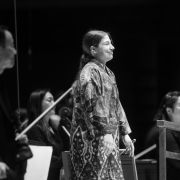
In a series of opening remarks, conductor Dalia Stasevska drew the audience’s attention to Eastman’s unusual orchestral component, which included bass clarinets, contrabass clarinets and contrabassoons in pairs of three. The symphony chronicles the end of a romantic relationship, and the immensity of the orchestration reflects the charged, complicated feelings that linger in the wake of a break-up. The work opened with slow, quasi-Romantic strings playing in unison, with the heavy wind complement and insistent cellos following as an interruption the temporary ecstasy voiced in the beginning. Massive percussion, including multiple timpani, thrummed like a heartbeat or a headache, depending on the moment. Woodwind bursts asserted themselves before fading to nothing – a stormy affair that ended as quickly as it began.


The Philadelphians offered an utterly convincing introduction to Eastman, shepherded by Stasevska, who previously led the work during the BBC Proms. Despite the symphony’s wordy and arch subtitle, “The Faithful Friend: The Lover Friend’s Love for the Beloved”, Eastman’s melodies were warm and graspable, the music’s emotion palpable without much work to be done. Eastman rarely left behind fully drawn scores, and the program note stated that an average performance length ranges anywhere between 12 and 22 minutes. At around 15, it felt all too fleeting.
The unusual program continued with John Williams’ Tuba Concerto, performed by Carol Jantsch, the orchestra’s Principal. The music radiated the bright, shiny quality one associates with Williams, but the tuba’s role felt divorced from the rest of the proceedings, as if it were left to improvise amidst a short symphony. Jantsch impressed with seamless register leaps and a warm, mellow tone, but the proceedings turned monotonous long before its 20 minutes were up. There remained isolated pleasures to savor, though – especially an intimate duet between Jantsch and Elizabeth Starr Masoudnia on English horn near the start of the second movement.
And what does a tubist choose for an encore? In this case, Jantsch enlisted two of her colleagues – Assistant Principal Percussion Charlie Rosmarin and trombonist Jack Grimm, here playing an electric keyboard – in a combo orchestration of the song New Beastly, by the American jazz pop band Vulfpeck. The tune’s character and the warm rapport shared by the three musicians made for a more pleasurable experience than much of the concerto that preceded it, briefly turning Marian Anderson Hall into a lively juke joint.


Mendelssohn’s Italian Symphony doesn’t necessarily lend itself to revelations, but it was easy to admire Stasevska’s serious approach to this familiar bagatelle. She created the buoyant mood a listener expects in the outer movements, but she truly drew the audience in with her refined, contemplative Andante and charming Con moto moderato. Although brass and timpani tend to dominate this work, Stasevska made lovely space for delicate woodwind playing, especially from flutist Jeffrey Khaner in the third movement.