

Universities have a long and storied history as centres of debate and philosophical discourse. It’s fitting, therefore, that the Royal Academy of Music’s autumn term operatic offering is Strauss’ Capriccio, a whimsical piece that has at its heart that great question: is poetry or music the greatest art form? Strauss’ last opera is not regularly performed and the RAM is to be applauded for its ambition in staging a work that is neither a natural crowd-pleaser nor an easy one for a cast of young singers.

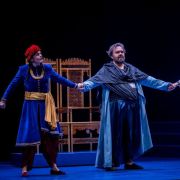
Director Olivia Fuchs updates the opera from 1770s France to the Vichy period, reasoning that we cannot ignore the wider context in which the opera was composed. In her chateau, the Countess Madeleine is being moved out and her possessions requisitioned by the new regime, but she and her circle carry on life as if the outside world does not exist, almost determinedly focusing on comparative trivia as a coping mechanism. It’s a concept that sounds reasonable, but is half-hearted in its execution. Only in the figure of La Roche – the theatre director – does it really come off; with a stark yellow badge denoting Jewish heritage, his great exposition “Hola, ihr Streiter in Apoll!” becomes loaded with despair, the line “Was wisst ihr Knaben von meinen Sorgen? (What do you know of my worries)” loaded with meaning. Desperation, a sense of pride and heritage, and that overwhelming fear of the period all blend together in a forceful punch to the guts.


Designer Yannis Thavoris has lavished attention on the sets: there’s plenty of detail in his depiction of a grand house in disruption, and he manages to surprise with a beautiful set-change for the final scene that captures the grandeur of the old French elite. Fuchs’ direction is sensitive and natural; her cast are not left standing awkwardly, and the chemistry – and camaraderie – among the characters feels nicely judged.
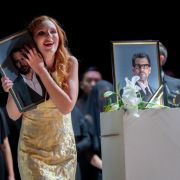
To do Strauss well, the casting director needs to find a fine leading lady. In Madeleine Perring, the RAM has landed on a soprano with the spark and spontaneity that is typical of the best Straussian singers. The final scene is a tour de force, and Perring rode the waves with aplomb, her clean, effervescent soprano surging across the registers, entirely comfortable in the higher register. If diction occasionally lacked clarity, this will sharpen in time. A commendable performance.

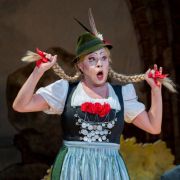
As the Count, Harrison Robb showed a thrusting baritone, suave in his pinstripes as he flirts with Clairon. Seho Oh’s mellow bass belied his impassioned performance as La Roche. Woogyeom Kim gave particular pleasure as Flamand, showing sunniness in both tenor voice and in disposition; his enjoyment in his performance was compelling. Joel Robson was a more lugubrious Olivier, a fine foil for Kim. Viktoria Melkonian showed a smoky mezzo as Clairon, cheerfully vamping with slightly overused hand gestures.


In the pit, Christopher White led the Academy’s orchestra in a thoughtful reading of the score; dainty in the opening with plenty of verdancy in all the right places, especially in that glorious final scene. The performance was dedicated to the late Dame Felicity Lott, with whom Capriccio was associated early in her career. I suspect she would have been satisfied with this production.