Of Tchaikovsky’s three operas based on Pushkin, Mazeppa is without doubt the black sheep. Composed between Eugene Onegin and The Queen of Spades, it has never achieved anything like their popularity. This new production at Oper Frankfurt – a co-production with Festspiel Erl, where it was unveiled in 2024 – was the first time it had been seen in the city.

It’s a work that shows Tchaikovsky at his darkest; a blood-thirsty historical drama, in which the human relationships sit awkwardly, despite the composer’s best efforts to breathe life into them with some wonderful music. Central to it all is the ambiguous figure of Mazeppa, whose tender love for the much younger Mariya is difficult to square with his brutal actions as military leader – including the torture and execution of her father. Mariya, for her part, is uncomfortably passive, buffeted around by events and decisions over which she has little say, reduced to madness in the third act.


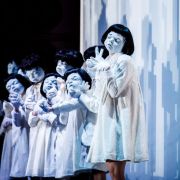
In his updated production, Matthew Wild does away with the opera’s historical and geographical context (although the odd anachronistic mention of the Tsar remains, surtitles otherwise shorn of specific references) in what feels like an attempt to focus squarely on the characters and create a convincing framework for their actions. Instead of Ukraine at the turn of the 18th century, we’re in the present day, somewhere, one assumes, in Eastern Europe. It’s a world of gangsters, henchmen and heavies, with Mazeppa recast as a crooked politician. Everything is realised in tireless detail and with unflinching realism.

In Herbert Murauer’s set, a grey wall stands a few metres back from the front of the stage, sliding panels revealing a series of rooms in which the gangsters carry out their unsavoury business. The mass of people they control is confined to the area in front. During the short introduction, we are shown the backstory of the young Mariya’s fascination with Mazeppa, who early in his career is offered shelter by her parents after a violent altercation.

But this background does little to make that relationship seem more believable, while the chance is also missed to use the updating to help make certain elements of the plot more believable – primarily Mazeppa’s murder of Mariya’s father, Kochubey, or Maria’s willingness to abandon her parents for her unlikely lover. The graphic nature of the violence we see doesn’t help elicit sympathy for Mazeppa, either.


But here Petr Sokolov’s performance is perhaps slightly to blame. Sporting greying hair, thick specs and a series of dour suits and ties, he struggled to communicate much charisma and, while he sang smoothly, the voice was short on character. Sympathy lies primarily with Alexander Roslavets’s terrific Kochubey, who retained a gruff nobility throughout Act 2’s indignities, and above all with Karolina Makuła’s moving Lyubov – his wife, Mariya’s mother and without doubt the most fully believable character in the opera. John Findon was robust if a touch raw as Andrey, the tacked-on tenor love interest.
Best of all was Nombulelo Yende as poor Mariya. She brought touching dignity to the role and sang with open-hearted passion with a voice of gleaming beauty. Her final scene, in which she’s shown retreating into her childhood as she sings a lullaby to a bloodied teddy bear, was supremely moving. So too was the chorus’ hushed a cappella lament at the end of Act 2; and they were no less superb singing full throttle in the grand crowd scenes.

Conductor Karsten Januschke whipped up the drama rousingly in the pit, and the Frankfurter Opern- und Museumsorchester played with impressively burnished tone, lyrical sweep and power. Overall, though, neither their best efforts nor Wild’s production quite managed to paper over the work’s cracks.