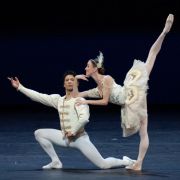
On Sunday afternoon, I was really worried about being home in time to watch the red-carpet pre-show before the Academy Awards. I needn’t have worried, as the American Ballet Theatre show got out in record time. If you like your ballet programs short and sweet, ABT’s double bill of Raymonda: Grand Pas Hongrois with Ratmansky’s Firebird was certainly that. Barely an hour and a half including a long intermission.

The good news is, the two ballets showcased the company well and provided a strong contrast. Raymonda: Grand Pas Hongrois is the most well-known act with the wedding variations, pas de deux and famous clapping variation. The entire ballet is rarely performed outside of Russia, due to a rather ponderous and Islamaphobic storyline. But Glazunov’s music is wonderful. George Balanchine plundered it for several ballets: Pas de Dix, Raymonda Variations and Cortège Hongrois.
Taken out of context, without any scenery, the whole thing comes across as a little random. There were variations (well performed by Sierra Armstrong and Elisabeth Beyer) but who were these women? Why were they dancing? Beyer was very impressive in the ‘hops across stage on pointe’ solo that Balanchine ‘borrowed’ from liberally for variation #1 in Raymonda Variations.
Skylar Brandt and Herman Cornejo were Raymonda and Jean de Brienne. Both dancers were technically accomplished but bland dramatically, as is often the case with excerpts from full-length ballets that are taken out of context. Skylar Brandt is an incredible technician. Her retiré passés were so fast, so accurate, so musical. But she smiled a little too bright, without the hauteur and deliberateness I think is necessary to make the clapping variation work. Raymonda is not Kitri. She didn’t seem like a Hungarian princess. Herman Cornejo’s scissor cabrioles are still a wonder and he partnered well in the pas de deux.

Ratmansky’s Firebird seems like a deliberate reaction to the more classical Fokine and Balanchine’s versions, with their iconic red tutus and majestic characterization of Mother Russia. Ratmansky’s ballet is cheeky and sort of psychedelic, almost like a spoof. Simon Pastukh’s scenery and Galina Solovyeva’s costumes deliberately avoid the Russian folklore feel of, say, Marc Chagall’s backdrops for Balanchine’s version. They’re in loud, bright colors and funky silhouettes. One of the most striking scenes is the burning trees in the background.
The Firebird is in a red body suit with red tassels hanging off the bodysuit. Surprisingly, she’s not unique. She’s one of a flock of birds, and her costume is the same as her compatriots. Her steps are a lot of off-balance pirouettes and surprisingly few jumps for a ‘bird’. It’s one of ballet’s greatest motifs that bird-like figures from Odette to Bluebird come onstage jumping, although she does do a series of high flying sissones later in the ballet. Catherine Hurlin was captivating and commanding as always, but the role is surprisingly small and low impact. The way Ratmansky tells the story, the Firebird is almost a side character. Prince Ivan (Daniel Camargo) had a small role that was completely partnering. He was funny and naive, the way most Ivans are regardless of version.
Ratmansky’s is way more inspired by the wacky world of Kaschei and the enchanted maidens. Kaschei is a mustache-twirling comic villain. The enchanted maidens wear green, frizzy wigs and tatted green dresses. They use exaggerated, herky-jerky steps that resemble Bella Baxter’s gait in Poor Things and Lucille Ball facial expressions. This bizarre harem captivates Ratmansky’s interest. He inverts traditional pas de deux expectations. The Maiden (SunMi Park) is held aloft in a big overhead lift, but she flexes her feet and kicks her legs like a child. It is different from the rather pure, sweet maidens of the Fokine and Balanchine versions.
Cory Stearns (retiring in June) was a fabulous Kaschei. He has always been more interesting in these offbeat roles than he is as a traditional prince. He was clearly relishing the opportunity to be camp and evil. SunMi Park was genuinely bizarre as the Maiden. When she became more traditional in the finale, it was almost sad.
Ratmansky’s Firebird shouldn’t be anyone’s first introduction to the story. Fokine and Balanchine’s versions tell the story better. But it is an interesting, thought-provoking satirical take on those classics.