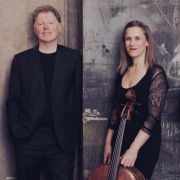
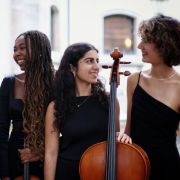
The Fibonacci Quartet, making their first appearance in Sheffield as guests of Music in the Round, introduced themselves with a performance of three quartets – classical, romantic and twentieth century – that revealed much about these players' exceptional musicality. Add to this a self-arranged mash-up of two Gershwin standards as an encore and it was easy to understand why the nearly full house greeted the quartet’s playing with such vocal enthusiasm. It was an almost perfect evening – where the "almost" should not overly detract from playing of virtuosity, sensitivity and, where necessary, phenomenal power.

Bartók’s String Quartet no. 5 provided the centre-piece. Cellist Findlay Spence, introducing it, spoke vividly of the two ‘night music’ slow movements, evoking the rustling of unseen creatures in the darkness, standing on either side of the limping 9/8 alla bulgarese scherzo that forms the capstone of the quartet’s ‘arch’ structure. The players gave thrilling voice to Bartók’s deep love for the folk music traditions at the core of his art in this scherzo, as they did to the nocturnal murmurings of the slow movements. Bartók’s obsession with number theory is evident in the quartet’s precisely structured patterns, but what emerged most forcibly from the Fibonacci’s performance was the music’s rawly physical sense of abandonment. Spence suggested there were moments in the quartet that would test the players to the limits of their individual and collective capability. All one can say is that it didn’t show.


Schumann’s quartets don’t see the light of day all that often, but on the basis of the Fibonacci’s performance of the String Quartet in A major, Op.41 no.3, they really should be programmed more regularly. Written in less than a week, the work has much of the intimate, mercurial and often obsessive quality of his piano music, but there’s also an almost classical restraint in matters of formal structure, as in the taut sonata form first movement. But set against this order, the composition overflowed with Schumann’s love for his new wife Clara and that tenderness lay at the heart of this performance, right from the yearning falling fifth figure of the opening bar, its ‘Clara’ theme. Elsewhere the Fibonacci Quartet were wonderfully alert to the way Schumann disguises the placing of the down beat, giving their reading a delightfully hesitant character, especially in the halting opening to the Assai agitato second movement.
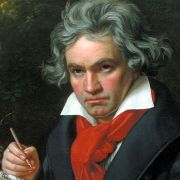
What, then, of the “almost”? It seemed to me that compared to the other items on the programme, the Fibonacci’s performance of Beethoven’s String Quartet in F major, Op.18 no.1, was curiously constrained, as though they were unwilling to let the music off its leash. It was, in many ways, a reading of both technical precision and collective unanimity, something close to flawless. The outer movements were seamless in the shifting of focus from voice to voice. The slow movement was refined and reflective – but Adagio affetuoso ed appassionato? Not so much here, and thus the extraordinary, vehement outburst towards the end of the movement passed without grabbing its audience by the throat. One wonders what might have happened, had the Beethoven been programmed last in the concert rather than first.


Still, the I got fascinating rhythm(!) Gershwin encore showed what happens when this quartet really decides to let its hair down. A genuine re-composition rather than merely an arrangement, it suggested that the Fibonacci Quartet has many strings to its bows.