International violin competition juries are often said to dread hearing the same concerto repeatedly. Against this backdrop, Lisa Batiashvili’s return to her Hamburg home stage over two consecutive evenings with the Oslo Philharmonic acquired an unexpected twist. Only days before the second concert, the announced Sibelius concerto was replaced by Tchaikovsky’s – identical to the programme the night before. Some listeners attending both performances may have felt a momentary disappointment. What followed, however, was a persuasive reminder of why Tchaikovsky’s concerto withstands repetition in good hands.

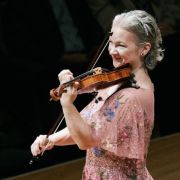
Batiashvili’s performance showed a level of granularity that made even the most familiar phrases feel newly etched. This was especially evident in the concerto’s long, high-register cantabile lines, sustained on extended bows with unwavering intonation and tonal focus. Vibrato was used sparingly, lending her sound a clarity that felt almost classical in restraint – even in passages of rapid string crossings and double-stopping. Musical sentences were formed with youthful directness: no indulgence, no rhetorical excess and no visible effort to ‘perform’ emotion. The result was a distinctly modern reading, emotionally direct and unsentimental, yet free of hard edges or any trace of calculation.


Her Guarneri violin projected a sound that was both clean and penetrating, capable of noble breadth, an instrument that spoke with authority. Even in the concerto’s most exposed moments – the expansive cadenza with its wide position shifts, or the finale’s relentless high-speed articulation – the tone remained centred and unforced. This clarity of sound found an ideal counterpart in Klaus Mäkelä’s Oslo Philharmonic. Mäkelä’s approach, as ever, was youthful, forward-moving and energetic, yet tightly controlled. The orchestra’s sound unfurled in layered planes, from woodwinds to strings, creating a sense of vast spatial depth, like mountain ranges receding into the distance.

The second half, devoted to Sibelius’ Lemminkäinen Suite, unfolded in a wholly different temporal dimension. Here, Mäkelä demonstrated the art of ‘slow cooking’ at its most compelling, shaping Sibelius through patient immersion in a dense sonic ecosystem. Again and again, he began from the faintest rustling of sound—barely audible whispers in strings or woodwinds—allowing the music to emerge gradually into a gigantic sonic world of remarkable depth and scale.
In Lemminkäinen and the Maidens of the Island, Mäkelä let the music shimmer with restless allure and latent danger, its constantly shifting textures and buoyant rhythms suggesting seduction already shadowed by flight. The Swan of Tuonela unfolded as suspended time itself, the cor anglais floating above gossamer orchestral layers like an otherworldly voice. In Lemminkäinen in Tuonela, the music grew dark, its slow, inexorable motion revealing grief, tension and renewal coexisting within the same dense harmonic space. Lemminkäinen’s Return released the accumulated energy into forward momentum, its exhilaration feeling earned the culmination of a vast sonic journey patiently woven from silence into resonance.


The hall testified to Mäkelä’s popularity – phones repeatedly raised by enthusiastic followers – yet these distractions did not alter the performance in the slightest. With Nordic firmness and patience, Mäkelä remained wholly focused and Batiashvili matched him in poise; together they rose above the noise to deliver a performance of unwavering artistic conviction.
This concert was promoted by DK Deutsche Klassik