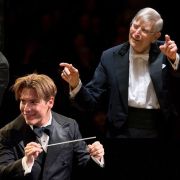
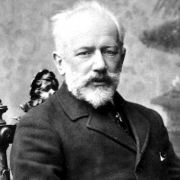
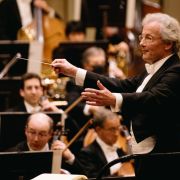
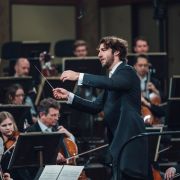
On Thursday, the Oslo Philharmonic returned to Vienna’s Konzerthaus, joined by violinist Lisa Batiashvili and conductor Klaus Mäkelä, for a program pairing two of the orchestral repertoire’s most well-reinforced pillars for the hall's Meisterwerke series: Pyotr Ilyich Tchaikovsky’s Violin Concerto and Dmitri Shostakovich’s Eighth Symphony. With works so deeply embedded in the collective musical memory, interpretation rather than discovery was always going to be the central question. Indeed, under Mäkelä’s dynamic baton and featuring star violinist Batiashvili, the orchestra presented an evening of immense engagement and virtuosic force, though its unrelenting intensity proved both its greatest strength and, at moments, a point of contention.


Batiashvili’s account of the Tchaikovsky concerto confirmed why she remains one of the most compelling violinists of her generation. Her sound, glowing and pliant in lyrical passages, combined virtuosity with a palpable willingness to take risks. At times, however, that boldness – mirrored by an orchestra playing with conspicuous commitment – led to moments in the outer movements where ensemble cohesion felt less than settled. The second movement Canzonetta proved the exception and the highlight: here, soloist and orchestra found an easy, playful rapport, relishing both the movement’s melancholic songfulness and its dance-like syncopations.
The encore, Ole Bornemann Bull’s Saeterjentens søndag, offered an unexpected moment of inwardness. Rather than a solo display vehicle, the piece – rooted in Norwegian folk idioms – was shaped collaboratively by Batiashvili and the orchestra, its simplicity and restraint providing a welcome contrast to the concerto’s extroversion.

After the interval, Shostakovich’s Symphony no. 8 in C minor unfolded with unrelenting intensity. Mäkelä’s reading emphasized the work’s brutality and oppressive weight, a defensible approach given the symphony’s wartime origins in 1943. The Oslo Philharmonic responded with ferocious commitment, particularly in the low strings and brass, whose climaxes were searing and uncompromising. For me at least, by the third movement the sheer dynamic force began to feel overwhelming. Mäkelä’s characteristically broad brush strokes brought visceral excitement, but some passages seemed to cry out for greater (dynamic) refinement.


Overall, however, this was a successful and often gripping evening, driven by a highly engaged orchestra, a fearless soloist and a conductor of undeniable charisma. If there were moments when I feel less might have said more it is a subjective impression perhaps shaped by my proximity in the hall, or simply my ear’s fatigue. Even so, the concert more than affirmed Mäkelä’s flair and Batiashvili’s artistry and was warmly received.