Purcell’s Dido and Aeneas contains music whose beauty hasn’t been surpassed in the four centuries since it was written, but it’s not often that you see the tragedy fully staged, even in the United Kingdom. Prague National Theatre aren’t exactly specialists in early opera, so putting on seven performances of Dido was a bold move, as was the choice of Alice Nellis as director, most acclaimed for her work on film. In the grey-and-gold intimacy of the Estates Theatre last night, however, the results were triumphant.

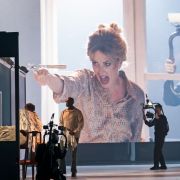
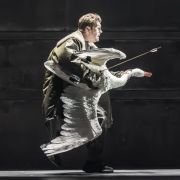
Nellis’ staging accomplishes the paradoxical feat of being faithful to Baroque traditions at the same time as being fresh and innovative. Matěj Kibulka’s sets are panels which come in from the side at different depths – as you will see in the original stage machinery at Drottningholm or Česky Krumlov – but instead of being painted, they are transformed by video projection. The giant stone face of a classical hero or god – Jupiter or Aeneas, we don’t know – is projected onto the rear of the screen: it splits to reveal storms, evil spirits, or the sea on which Aeneas’ ships will depart. Kateřina Štefková’s costumes are neither photorealistic period drama nor modern dress: they’re more like a cartoon in which we see all the cues we need to place this in the time of the Trojan wars. The opera opens with a stunning effect in which a rocky landscape revealing itself to be a cloud of grey chiffon which disappears as it turns out to be, in reality, a pile of chorus members.


Members of the regular National Theatre orchestra were joined by seven musicians from Czech early music specialists Collegium 1704, who also provided the chorus. Under the baton of Michael Hofstetter, they played out of their skins: there was verve and drive as well as beauty of instrumental sound for the whole performance, powered by the percussion of Martin Novák and underlined by the theorbo and Baroque guitar of Jan Krejča and Barbora Hulcová. The chorus defied their small numbers, singing with quality of line and ensemble as well as energy aplenty.

Dido and Aeneas would normally run for about an hour and was extended here by 15 minutes or so of “masque”, stitched together from portions of The Indian Queen, in which Fate and Envy vie for the fate of Zempoalla, Queen of the Aztecs. It’s placed as a divertissement for the royal couple, fitting in dramatically well enough, and it provides the opportunity for some spectacular entertainment from three acrobats and half a dozen dancers, clad in vividly painted body suits – they could be Aztec warriors, snakes or something from science fiction – and rolling on medicine balls. I’m not convinced that the music for The Indian Queen is really up to the standard of Dido, but the masque made for an appropriate interlude and provided the chance for the evening’s most spectacular costume, for Tomáš Šelc as the gleefully malevolent Envy, his grey barrister’s wig merging into the body and tail of a serpent.

Everyone’s vocal acting was well up to the job, in contrast to a great deal of Baroque opera I’ve heard where the focus is purely on beauty of voice. In the title role, Marketa Čukrova was suitably regal and tortured, negotiating Dido’s vocal lines with elegance. I could have wished for more legato in first half hour or so, but by the end, the legato had been restored, with the opera’s greatest hit “When I am laid in earth” everything we could have wished for. Lukáš Bařák was a suitably robust Aeneas. Ekaterina Krovateva was the pick of the main singers, throwing herself into the character of Dido’s confidante Belinda while providing deliciously creamy high notes. Lenka Pavlovič and Marie Simunková stole the show with their boundless evil enthusiasm as the two enchantresses. Special mention needs to be made of everyone’s diction, although there was the odd Czech accent leaking into the English, this was good enough to remind us of the exceptional poetry of Nahum Tate’s libretto, where every couplet is infused with meaning.


What this production achieved was to replicate exactly the purpose of early opera: to surprise, entertain and provide open-eyed wonderment, even as the music transports the audience to a higher plane. It makes the best possible case for Purcell's masterpiece.