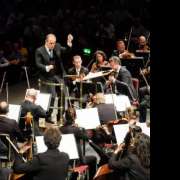
In the concert hall, Robert Schumann is a composer who needs all the help he can get. Received wisdom has it that he couldn’t orchestrate for toffee – a myth surely long since debunked by historically-informed performance practice – and his rambling developments can confound even the sharpest of conductors. With his Berlin, London and Munich orchestras, Sir Simon Rattle has long championed the composer’s symphonies along with the strange secular oratorio Das Paradies und die Peri, but at this evening’s all-Schumann Prom he brought the period instrument forces of the Freiburg Baroque Orchestra.


“I had hoped I wouldn't fall in love with another orchestra, but in fact I did,” Rattle has said of the FBO. It’s easy to hear why. It has a very particular patina – grainy, nutty, something quite autumnal in colour that suited both the month and the repertoire. The way the trombones at the start of the Second Symphony emerged gently through the mists, the tangy clarinet of the wonderful Lorenzo Coppola, the knotty bassoons and double basses, all painted a landscape in glowing colours.
They made an immediate impression in the overture to Schumann’s only opera, Genoveva, Rattle’s whippy baton movements stirring them into action, the earthy natural horns and trumpets adding pungency.
Schumann’s Violin Concerto was composed in 1853, during failing mental health, months before a failed suicide attempt after which he committed himself to an asylum. It was written for his friend Joseph Joachim, who never performed it publicly, writing to a friend that it demonstrates “a certain exhaustion, which attempts to wring out the last resources of spiritual energy”. After Schumann’s death, Joachim advised Robert’s widow, Clara, against publication, instead stamping an embargo of 100 years on its performance. It took 84 years until that embargo was broken and the concerto’s been playing catch-up ever since.


Isabelle Faust is a strong advocate and her reading made a fine case for the work, although I still harbour doubts about its effectiveness. The opening movement is the most satisfying: experimental and dramatic, it is chewy, muscular music, striving for something, frowning a lot. Faust’s playing was compact, with wiry double-stopping, digging into the rhapsodic lines. Her long-breathed elastic phrases in the intermezzo-like central movement whispered, Rattle and the FBO providing the softest of cushions. But the courtly polonaise-like finale overstays its welcome and it rarely took flight here.
The performance of the Second Symphony was immensely satisfying, Rattle injecting a sense of impetus throughout. Conducting without a score or podium, he moved around the space, almost stepping through the cellos at one point. The Scherzo, Schumann at his most Mendelssohnian, scurried and bustled, Rattle accenting the second violins, until a furious accelerando whipped up the excitement. Despite the lovely range of pastel colours, Rattle couldn’t prevent the slow movement from meandering, but there was tremendous urgency to the finale before the stately, affirmative coda. The glass of wine Rattle brought principal double bass Dane Roberts was well deserved.