Frédéric Chopin and César Franck, neither a natural orchestrator, built their reputations at the keyboard rather than on the symphonic platform. Both made their careers in Paris and both left orchestral works that, for all their ambition, can feel structurally uneasy. This concert set them side by side, testing how far imaginative performers might turn those limitations into strengths.

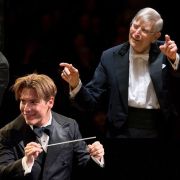
Chopin’s Piano Concerto in E minor – published as no. 1 despite being the second composed – remains a work in which the orchestra all too easily becomes dutiful accompaniment. Here, however, conductor Jean-Luc Tingaud took care to shape the opening tuttis with real dramatic purpose, before scaling the sound back to a near-whisper for the soloist’s entry. The effect was to frame, rather than merely support, the piano line.


Louis Lortie responded with playing of poise and refinement. His phrasing in the first movement avoided grandstanding, instead favouring a vocal, bel canto line, delicately ornamented yet always purposeful. Crucially, Tingaud maintained transparency in the orchestral texture, allowing inner details – so often obscured in this concerto – to register cleanly. Lortie’s passagework, including the treacherous runs in thirds, was dispatched with clarity rather than display.
There was a shy, vernal delicacy to the opening of the second movement, as Tingaud brought a Mozartian lightness to the orchestral texture. This provided an ideal foil for the warmer hues of the solo line, the interplay between the two finely judged. The final pianissimo was nothing short of exquisite. Lortie brought mercurial wit to the rustic dance of the finale, its flashes of arpeggios and pearly passagework deftly handled. The kaleidoscopic shifts of key were navigated with ease, maintaining a sense of buoyancy and forward momentum. An encore – Chopin’s Étude in C sharp minor – was delivered at formidable speed, yet retained its essential articulation.
If Chopin’s concerto poses questions of balance, Franck’s Symphony in D minor presents a challenge of cohesion. Its cyclic structure can feel more theoretical than inevitable, and its orchestration, particularly in the strings, is not always grateful. Conducting from memory, Tingaud showed a clear grasp of the work’s architecture, shaping the first movement with a steady accumulation of tension. The lower strings, in particular, established a dark, unsettled tone at the outset.


There were moments, especially in more exposed passages, where the upper strings sounded pressed, and the balance did not always favour clarity. Yet Tingaud’s broader control held firm, and the climaxes – driven by incisive brass – carried conviction. The Allegretto, combining slow movement and Scherzo, was sensitively handled, its cor anglais melody unfolding with unaffected simplicity over a gently flowing accompaniment. In the finale, the return of earlier material was integrated with assurance, the performance finding momentum without resorting to bombast.
What this concert ultimately suggested is that neither Chopin nor Franck needs to be ‘rescued’ from their supposed orchestral shortcomings. Rather, in performances of this intelligence, those very limitations can sharpen the focus: on line rather than mass, on colour rather than sheer weight. It made for an evening less about symphonic grandeur than about musical perspective – and all the more compelling for it.