Victorian Opera brings a totally compelling production of Britten’s ghost story – or is it a study in psychology? – The Turn of the Screw to Melbourne. Based on the 1898 novella by Henry James, Britten’s take dates from 1954, not long before the fondly, or scarily, remembered movie version from 1961 (entitled The Innocents). What all versions have in common is keeping us off balance in knowing whether the Governess is seeing real paranormal phenomena or suffering from a derangement of her own mind, and the most important effect to this end is atmosphere. In some ways, the composer has the upper hand in deploying a musical idiom, and Britten’s score is a masterpiece in subtlety and economy of means in achieving this balancing act. Stuart Maunder’s production pulls out all the operatic stops in fulfilling this aim.


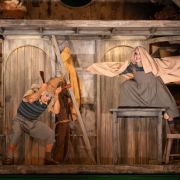
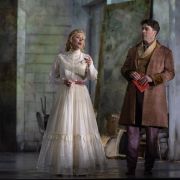
The Prologue, sung by tenor Kanen Breen who also plays Peter Quint, comes on stage looking dapper against a background on which a bare branch throws a shadow, then the Governess appears with her baggage. After expressing her hopes for the new position, flats slide down at the back and in from the side representing a panelled interior, which changes to an external tower, a chapel entrance and so on in a versatile set by Roger Kirk. As the story progresses, a full moon occasionally appears throwing that branch into relief. The lake is represented by a length of material spread across the stage, the mood is enhanced by dry ice (or whatever is now used for that effect), and a very effective lighting scheme, thanks to Trudy Dalgliesh. Miles’ bed slides onto the stage as appropriate, and a desk tells us we’re in the schoolroom.

The costumes, also by Kirk, appear to be Edwardian, not unusual in productions of this work, although James specified the mid-19th century. Peter Quint and Miss Jessel wear outfits looking to be of an earlier era, in shiny material of a spectral greenish hue, Quint sporting a somewhat outré red wig but without James’s “rather queer whiskers”.
Orchestra Victoria was conducted by Britten specialist Paul Kildea in an immaculate rendition of the score, with just the right tempi and dynamics to enhance the atmosphere, always in the service of the singers. Particularly eerie music came from the flute (Lisa-Maree Amos), and rippling through it all it the piano, and celesta, of Phillipa Safey.


The role of the Governess was totally inhabited by Perth soprano Rachelle Durkin, with her powerful gleaming soprano and riveting stage presence. Beginning with her eager-to-please response to the children’s guardian, she covered the range of emotions required in an acting as well as singing tour de force: relaxing in her new environs, she loosened her virginal collar effectively inviting the attentions of the undead (or her own desires), recoiling in horror from what she has invoked/let in, fiercely determined to protect the children, finally collapsing in despair.

The rest of the cast was no less impressive. The always entertaining Breen was suitably alternately terrifying and insinuating as Quint, contrasting with his business-like Prologue. His co-apparation, Miss Jessel, was equally well portrayed by soprano Michaela Cadwgan. Soprano Sharon Prero was got up to look suitably mature as Mrs Grose in a curly grey wig, belied by her firm bright soprano. Genevieve Gray as Flora, on the other hand, needed to play younger than her actual years, and managed to convince as a schoolgirl, singing with beguilingly pretty tone. Particularly impressive was the singing and acting talent of treble Oliver Thadoe Naing as Miles, projecting the right amount of ambiguity in his role (is he bad? misled? corrupted?) and – spoiler alert – being very convincingly dead at the end. Bright futures surely await these last two.