With the supposed national flagship Opera Australia barely present in Melbourne these days, a number of local companies more than compensate, notably Melbourne Opera and Victorian Opera. The latter has produced a memorable performance of Monteverdi’s L’incoronazione di Poppea, with reservations only about the musical arrangement.

Updating the staging to emphasise the universality of the story is one thing, but updating the orchestration is something else, particularly given that the singing style remains of its original time (1643). The arrangement is originally the work of noted Australian composer Elena Kats Chernin, with a performing edition “realised” by conductor Chad Kelly; not just modern instruments, apart from a theorbo, but the inclusion of a saxophone and a piano for the continuo proves distracting. That conductor Kelly played bongo drums as well as piano was impressive, if not entirely welcome. Jazzy themes interweaving with Monteverdi’s long-breathed elegiac string passages tend to throw one out of the mood, but it is all noticeably less intrusive in the second half, or perhaps one gets more used to it.


In every other respect, this is a brilliant realisation. The opera is presented in two parts, with an interval after the death of Seneca. The plot is somewhat streamlined; the interlude with two soldiers preceding our introduction to Poppea and Nerone is omitted, as is the scene between Damigella and Valletto, and the interaction of the deities Pallade and Mercurio with Seneca. Another goddess (Venere) is also absent, as are assorted other attendants and hangers-on. Some of their parts are assumed by others. Instead of being prepared for death by Mercury, Seneca is consoled by Liberto who is here more of a go-between than a captain of the Praetorian guard, and with whom it would seem Seneca is having an intimate relationship. It would appear that Ottone and Poppea are not actually married when she catches Nerone’s fancy, contrary to history as well as to the opera’s plot.
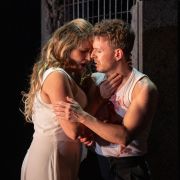
Otherwise it is pretty much as laid down by Monteverdi and his librettist Busenello, starting with the appearance of Fortuna, Virtu and Amore. The action is updated to modern times, with an organised crime setting, modelled by director Sam Strong in part on Brian de Palma’s Scarface, although it could be any similar movie. The setting features a semi-circular structure, supported by classical caryatids which light up with neon features which would grace any Floridian stronghold. These front curtained alcoves within which lurk bedrooms and bars. Costumes are appropriate, with Poppea appearing first in a pink slip, later in a fur coat which slips off to reveal a satin pink mini-dress. Nerone wears a tan suit over a white t-shirt, Seneca is a consigliere in business suit and 5 o’clock shadow. Ottavia wears a relatively severe olive green suit, while the three deities wear long floaty dresses.

The biggest surprise, and a great and not inappropriate piece of theatre (if historically dubious), is the ending. After Ottone is banished and Drusilla wishes to join him in exile, Ottavia is also banished and sings (movingly) “Addio, Roma”. At this point, Poppea produces a handgun and shoots Ottavia dead. She then takes out Ottone and Drusilla, who have lingered on the stage. Arnalta helps himself to Ottavia’s pearls before celebrating his new status as handperson to the new empress, the three deities appear to sprinkle glitter in the air, and Poppea and Nerone appear in gold outfits to sing “Pur ti miro” in front of the three corpses.


Soprano Meechot Marrero excelled in the title role, singing with commanding and accurate soprano tone and embodying the ruthless seductress holding Nerone and Ottone in her thrall. Both the latter roles were vocally transposed to lower levels from the original sopranist/alto parts. Nerone was sung by baritone Samuel Dundas, revelling in his imperial authority and singing with bronze resonance. Jeremy Kleeman was an ambivalent but well sung bass-baritone Ottone, torn between the disdainful Poppea and the innocent Drusilla. The latter was touchingly portrayed by promising young soprano Rachael Joyce. American mezzo-soprano Margaret Trubiano was an icily patrician Ottavia until reduced to almost inchoate fury by Nerone’s betrayal, and sang with powerful ringing tone. Bass David Greco was a dignified and warm-toned Seneca. The three deities were charmingly performed by Alessia Pintabona (Fortuna), Amelia Wawrzon (Virtu) and Mia Chenea Robinson (Amore). Tenor Louis Hurley was an entertaining Arnalta, and baritone Bailey Montgomery his opposite number, Nutrice.