This February, a pair of electric guitars will slip into the sonic bloodstream of the Czech Philharmonic. Then, later in the season, in May, audiences at Prague’s Rudolfinum will hear a new cello concerto written for and performed by Anastasia Kobekina. Both moments centre on Bryce Dessner, the orchestra’s first ever composer-in-residence, in a role that brings several strands of his musical life into rare alignment.

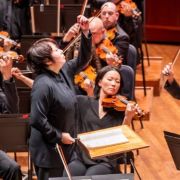
“It’s a bit surreal as a living composer to work with a group like the Czech Phil,” Dessner tells me when we speak by video call. “I’ve worked with many incredible orchestras, but to write specifically for such an exceptional group – one that really has a sound and has played a role in music history – is something else.”
That historical dimension has become increasingly central to his orchestral thinking. “There’s a connection to the past and the tradition of this music,” he adds, and to “the possibility of finding colours with the ensemble.”
Dessner’s orchestral imagination draws on several interwoven lineages. Henri Dutilleux is a touchstone – a composer whose fusion of French colour with literature, philosophy and visual art mirrors Dessner’s own omnivorous appetite for working across disciplines. Bartók and Stravinsky are also formative presences, alongside the current of American post-minimalism, a world Dessner knows well through direct musical relationships with figures like Steve Reich and Philip Glass.
Dessner’s musical life has never unfolded along a single track. In the late 1990s and early 2000s, he was composing, performing experimental and improvised music in New York, completing a master’s degree at Yale – and, in 1999, co-founding the American indie rock band The National as its guitarist and keyboardist.
Born in Cincinnati, the 49-year-old Dessner spent his early professional years in Brooklyn before relocating to France nearly a decade ago. Now based in the Basque region with his family, he moves freely between the scale of the symphony orchestra and more intimate ensembles.

Underlying the residency is a long-standing creative relationship with chief conductor Semyon Bychkov, who has become a key champion of Dessner’s orchestral work internationally. Bychkov has performed Dessner’s Concerto for two pianos (2017) repeatedly in recent seasons, also commissioning Mari (2020), a kind of “pastoral symphony” that Dessner created amid long daily walks in the forest with his young son. Bychkov performed it at the 2025 Nobel Prize Concert in Stockholm in December.


“It’s been an incredible relationship,” Dessner says, speaking of Bychkov. “He has really championed my orchestral writing.”
Two major works by Dessner anchor the new residency. The first, St. Carolyn by the Sea (2011), conducted by Jakub Hrůša in February, is often described as a double guitar concerto. Dessner himself places it differently. “The guitars in that work function the way harps often do,” he explains. “There’s no harp in St. Carolyn, so the guitars sit where two harps might – providing resonance, pulse, that kind of beating heart.” In this sense, the guitars operate less as virtuosic protagonists than as structural elements inside the ensemble.
Dessner situates the score within a lineage of orchestral expansion that reaches back through Berlioz’s use of the organ, Ravel’s saxophone, Messiaen’s deployment of the ondes Martenot and the synthesizers in John Adams’ Nixon in China. Yet the defining principle of St. Carolyn is restraint rather than amplification. “We don’t play them like electric guitars – we play them like acoustic instruments,” he says. “The amp itself is the sound. It has to be at a very low volume, but with enough roll that you can blend, tune and follow the dynamics of the orchestra.”
That approach keeps the guitars integrated into the orchestra’s sound rather than set against it. It also reflects a deeper question running through Dessner’s orchestral output.

“When you write for orchestra, you ask yourself what the point is in the face of so much inherited brilliance,” he says. “The repertoire is so beyond brilliant. What can you add?” For St. Carolyn, the answer lay in extending orchestral colour without turning the music into a crossover spectacle, and in discovering how guitars might function as part of the orchestra’s internal architecture.
Dessner first began exploring that territory when the New York Philharmonic invited him to perform with them – the first time the orchestra had placed electric guitar in a subscription concert. Since then, St. Carolyn by the Sea has continued to travel internationally. Performing it remains, for him, a rare opportunity to inhabit the orchestra from within. “It’s a chance to play with an orchestra, to have that stereo feeling of two guitars in space,” he says.
The second pillar of the residency arrives in May with the cello concerto Trembling Earth (2025). Dessner notes that he was struck by the breadth of soloist Anastasia Kobekina’s musical world. “She’s a really wonderful cellist – incredibly open-minded,” he says. “She plays the big classical pieces, but she’s also deeply into contemporary music and listens to people like Aphex Twin and Radiohead. I really wrote it specifically for her.”

Formally, Trembling Earth marks a departure from his earlier concertos. Instead of a conventional three-movement structure, the concerto unfolds as a single, continuous span – episodic in nature, closer to a tone poem or even a “cello symphony,” as Dessner puts it.
The cello’s capacity to emerge and recede within the orchestral texture shapes the work’s internal pacing. He describes passages that function as true cadenzas, alongside moments when the soloist can seem to disappear into the ensemble.
The expressive profile of the score oscillates between two poles. “It’s probably my most lyrical piece,” he says. “Anastasia is a very lyrical player.” At the same time, Trembling Earth carries rhythmic drive and friction recalling figures such as Lutosławski, Shostakovich and Stravinsky.
“There’s an intense energy to the music,” he says, “as well as these very lyrical, highly melodic moments.” He also returns repeatedly to the cello as a uniquely human instrument – one that can span soprano, tenor and bass registers and function as a complete voice within the orchestra.

The title Trembling Earth points toward a deeper layer of reference. Dessner draws on a quote from Macbeth – “Some say the Earth/Was feverous and did shake” – alongside a statement by the German painter Anselm Kiefer: “there is no such thing as an innocent landscape.”


These ideas connect the concerto to broader reflections on nature. “Nature has to bear witness to human calamity,” Dessner says. “But it also has its own rhythm. We’re testing that with climate change. But, somehow, spring does come.” In this sense, renewal and disturbance coexist within the work’s expressive world.
The concerto was written not only for Kobekina but explicitly for the Czech Philharmonic. “I tried to write very much for Anastasia,” he says, “but also for the Czech Phil. Their musicians are phenomenal.” Bychkov’s presence again completes the triangle of collaboration.
For Dessner, composition does not end at the page. “The music doesn’t live without the orchestra, without the conductor, without the soloist,” he explains. “I’m not trying to lock them into my work – I’m looking for freedom.”
The issue of “freedom” extends into the afterlife of the piece itself. After an initial performance in Dublin earlier this season, Dessner has been making subtle revisions ahead of the concerto’s Czech premiere. Once performers take possession, he says, he no longer feels ownership of the score at all – the music becomes communal. “Musicians exist in community,” he adds. “Music is a human art.”
Early in his career, Dessner had contemplated pursuing a path as an academic specialising in history. But an experience performing improvisations at a John Zorn concert in New York in the weeks after 9/11 made him realise that he could find history in music itself – an insight that reshaped the path he chose to follow.
For Dessner, collaboration is the through line connecting his orchestral writing, film scoring and theatrical work – and it increasingly draws him toward large, hybrid forms. One such undertaking now in progress is Night Sky with Exit Wounds, a monodrama based on the work of the Vietnamese American poet and novelist Ocean Vuong. Created with director Kaneza Schaal and written for mezzo-soprano Fleur Barron, the work is scheduled to premiere in 2027.
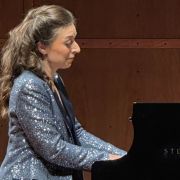
Another recent project gestures to the wider artistic field in which Dessner moves. Love, Icebox (2025), a solo piano work for Alice Sara Ott with Isabelle Huppert as narrator, draws its inspiration from the love letters of John Cage and Merce Cunningham. The world premiere in December took place alongside a major retrospective of the German artist Gerhard Richter – himself deeply influenced by Cage – presented by the Fondation Louis Vuitton.
This convergence of music, text and visual art mirrors how Dessner thinks about influence itself. For him, Richter’s process offers a metaphor for his own creative life. Richter once famously described copying a Titian postcard over and over until the image dissolved into pure process.
“That’s how my music works,” Dessner says. “Everything I’ve absorbed gets filtered through me, consciously or not.”
Throughout the residency, he sees the Czech Philharmonic as an active partner in this broader artistic conversation. “Programming a concert is like placing paintings next to one another,” he says. “The Rite of Spring has been heard a million times, but it won’t quite be the same after Trembling Earth – not because my piece offers anything ‘better’, but because that kind of dialogue is part of the reason we have new music.”
Bryce Dessner performs with the Czech Philharmonic from 4th–6th February at the Rudolfinum.
Dessner’s new cello concerto Trembling Earth is performed by Anastasia Kobekina from 6th–8th May.
See upcoming performances by the Czech Philharmonic.
See upcoming performances of music by Bryce Dessner.
This article was sponsored by the Czech Philharmonic.