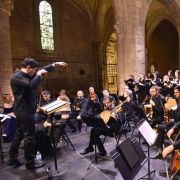
Orchestral life can be stressful at times – short-notice assignments of complex, lengthy music, performed often with unfamiliar conductors and soloists, and musicians separated on stage by large distances. But at its best, an orchestra can really become a family. This is definitely the case for Martijn Dendievel, the new chief conductor of the Flanders Symphony Orchestra, who assumes the role in January, adopting the baton of departing Kristiina Poska.

Dendievel has truly grown up with the orchestra, having had some association with it from the beginning of his life as a musician. In addition to his mother being an orchestral violinist, his cello teacher was the Flanders Symphony’s first cellist. “When the concerts weren’t sold out, he would get tickets for five or seven euros. He would say, ‘I have one ticket left. Do you want to come along?’”
“In fact, the moment that I decided to become a conductor was actually when I was at a performance by the Flanders Symphony,” Dendievel tells me when we speak by video call. “I must have been 9 or 10. It was in a performance of Shostakovich’s Cello Concerto. This piece starts very quiet… and at some point the timpani goes bang! Very loud. I remember the conductor: he’s just like this – ” Dendievel makes a small but deliberate hand gesture to demonstrate. “It wasn’t a huge movement, but it was just the focus of his wrist. I thought, ‘Ooh!’”
Dendievel’s tenure as chief conductor follows gifted chief conductor Kristiina Poska, who did much to rejuvenate the Flanders Symphony and secure a characteristic sound. “Kristiina’s Beethoven cycle with the orchestra was received in very high acclaim,” he says. “Her way of doing Beethoven has definitely brought the orchestra one step higher. With Kristiina, the orchestra fully embraced the fact that they’re not the biggest in size – they really embraced that sound, and that clarity that she was looking for.”


One of Dendievel’s first projects as chief conductor builds on Poska’s Beethovenian explorations – specifically, a focus on Felix Mendelssohn and Robert Schumann. “They’re among those composers that I’m hesitant doing with orchestras I don’t know,” he says. “This music needs such care with all the small details.” He compares Mendelssohn with Mozart – perhaps a natural comparison. “For some reason when people play Mendelssohn and Schumann, it can become a bit flat, often totally stretched-out dynamically. I think we should treat this music with an equal vivacity as we do with Mozart and Beethoven, and search for a lot of phrasing and fine lines – I think then this music really comes to life.”
Early experiences of much of this repertoire came through performances by the Flanders Symphony, Dendievel tells me. “It’s the orchestra that I heard most big pieces with for the first time. Things like Shostakovich’s Ninth Symphony, Tchaikovsky’s Fifth, a lot of Schumann symphonies”. Indeed his early connections with the orchestra led to a rather unusual request. “I was applying for the Curtis Institute in Philadelphia, and I needed a video of me conducting – and I didn’t have that video. I wrote a letter to the orchestra asking if there could be any possibility to assist in one of the coming productions – just to have a five-minute session. It was a bit audacious to ask for that!

“It didn’t happen, and in the end, I didn’t go to Curtis at all,” he continues. “I went in the other direction, to Germany, which was definitely a good choice in hindsight.” But the orchestra’s attention had been piqued – and within a couple of years, they approached Dendievel asking whether he would assist with conducting the orchestra. It’s a relationship that has been maintained ever since. I speculate that maybe that early audaciousness could be effective – Dendievel seems to agree. “I think especially with conductors, the only way to really get yourself noticed is sometimes just to be frank!”
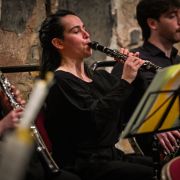
In the years since, he has gotten to know the majority of the orchestra’s musicians, sometimes on quite an intimate level. “Because I’ve seen them so much in rehearsals,” he tells me, “I’ve seen what works and what doesn’t. I know with every single player in the wind section, for example, how far I can push them in rehearsals. I know who has maybe a little bit more ego and who has zero ego at all. I know with whom I can get the most from when I speak with them in front of the orchestra, and when it’s better wait for the break and ask for some details without exposing them.”
This kind of intimate knowledge is gold-dust for conductors, often lacking when they are only guests, visiting an orchestra whose players are largely unknown as individuals. We reflect on a few other young conductors whose stocks have risen meteorically – as jet-setting guests, and then young new chiefs. In comparison, Dendievel’s career path, building a long-standing, personal relationship with an orchestra, could seem decidedly old fashioned. (“I even have sometimes discussions with my agents! I say, just don’t push it too much!”) But while the industry seems to have taken against it, building direct relationships with musicians on an individual level seems a much more natural way to work.

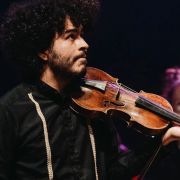
In addition to Mendelssohn’s Violin Concerto with Liya Petrova in January, and the Reformation Symphony later on, Dendievel accompanies cellist Anastasia Kobekina in a crisp, classical work: Haydn’s First Cello Concerto. “I think she is a great choice for doing the Haydn Concerto – she studied Baroque cello, but she’s going to play on a modern cello with us. It’s basically what we’re trying to do with Mendelssohn and the Schumann,” he says. “We’re not going to change our instruments – we’re not going to gut strings. But we do like to incorporate the things that musicians spend hours and hours of research on, to incorporate them into our playing.”


Soloists frequently join the orchestra for an extended period, rehearsing over several days and performing up to seven concerts, something Dendievel strongly advocates for. New commissions are also part of this season too – including a new Trombone Concerto by Flemish composer Frederik Neyrinck, for soloist Bram Fournier, who has performed contemporary music for years as well as performing in orchestras, including the Flanders Symphony. (“This is also a bit of a family affair,” Dendievel says.) Neyrinck’s idiosyncratic music is especially rhythmically inventive, he tells me.
I ask what might be characteristic about music-making in Flanders – is there a hybrid of different musical traditions? “We’ve always been a border region. And we’ve always been a bit stuck between the French and the German schools – both in terms of composition as well as in orchestral playing.” As a conductor, Dendievel also has some insight into his elder colleagues. “The three biggest Flemish conductors – Philippe Herreweghe, René Jacobs and Jos Van Immerseel – all came to conducting from different musical backgrounds. Their approach and leadership, which has inspired me a lot, is based on profound musical ideas, more than what you could call textbook conducting technique.” But this leads to a distinct difference of rehearsal culture among orchestras in the region. “Orchestras here are more open to vocal input, maybe more so than German or English orchestras, where things just need to go faster and be more efficient. Talking is not efficient.”
But orchestras being open and receptive to ideas coming from the conductor has to be a positive. Continuing to rehearse and rethink their existing repertoire is another characteristic aspect of the Flanders Symphony. Indeed, Dendievel argues Belgians don’t really appreciate how good they have it. “Belgium has got the best music-school system in Europe. Nobody knows about it!” The German system pales in comparison, he says. “We’ve got one of the best healthcare systems in the whole of Europe. Belgians are still not able to be happy with the hospitals and with the doctors. And they’ve got no clue!”
Now living in the Netherlands, seeing Belgium from a little bit of distance certainly helps. Dendievel is also keen to help the orchestra advocate for itself and firm up its position, financially and artistically, in a volatile political landscape. Based primarily in Ghent, the Flanders Symphony travels around the whole region giving concerts. He hopes it will be able to return more often to his home town of Bruges and its Concertgebouw – “definitely the best hall in Belgium” in terms of acoustics, he says. But Dendievel’s birthplace was the seaside resort of Ostende – home to one of Belgium’s most emblematic painters, James Ensor, whose canvasses explode with colour and strangeness, overflowing crowds, masked characters and hybrid persons.
I ask about this Belgian propensity to hybridity and surrealism. “I think Belgium as a state never really properly worked structurally,” Dendievel says. “It has always been a crossroads of cultures and of people,” with its own distinct, sarcastic sense of humour. But he sparks up: “Do you know the James Ensor Suite by Flor Alpaerts?” I don’t! “Four paintings by Ensor treated symphonically. I’m dying to put it on the program – it’s Pictures at an Exhibition but the Flemish version. He even quotes the Belgian national anthem in the first movement. It’s crazy and it’s so good.”
Martijn Dendievel and the Flanders Symphony Orchestra perform Mendelssohn’s Violin Concerto with Liya Petrova from 17th–21st January.
Dendievel returns with Anastasia Kobekina for Haydn’s Cello Concerto no. 1 from 28th March to 5th April.
See the Flanders Symphony Orchestra’s upcoming concerts.
This article was sponsored by the Flanders Symphony Orchestra.