With all its funding difficulties, staff redundancies and this season’s reduced programme, it’s an encouraging sign that Welsh National Opera can produce such a musically rewarding and intensely memorable La bohème. This current staging replaces one by Annabel Arden and ‘shoplifts’ the 2022 Glyndebourne production directed by Floris Visser. While it’s not homegrown, the casting and orchestral playing were both magnificent.

It took a while to adjust to the austerity of Dieuweke van Reij’s designs that suggest one of Hausmann’s navvies had bulldozed through the slums of Paris to reveal a single cobbled street placed between two cheerless apartment blocks, disappearing into an unknowing darkness. This striking concept does for an impoverished garret, the Café Momus and a shadowy quayside peopled by customs officials and ladies of the night. The gloom is matched by Jon Morrell’s fifty shades of grey costumes all atmospherically lit by Alex Brok.


Relief from the monochrome is offered by flickering flames within a stove embedded in a manhole, a slew of pink blossoms and Parpignol’s blood-red balloons, these being simultaneously colourful and creepy, and brought an eerie reminder of the 1973 film Don’t Look Now. More ominous is the clever personification of Death who, like Parpignol, is taken by a silent and impassive Christopher Lemmings who stalks the ill-fated Mimì at every turn. If the symbolism feels overcooked at times (skulls appear on the back of café menus), the final scene is quietly devastating as Death guides Mimì towards the Rue d’Enfer in an intensely moving exit that may bring a lump to one’s throat.

As a counterpoint to the bare necessities, there’s plenty of physicality from the quartet of penniless students, their lively movement almost drawing the eye away from the plain furnishings of Act 1, merely an easel, a table and a stack of chairs around which Rodolfo and Mimì express their feelings. The stage fills for the bustling café scene, the stacked chairs becoming handy for the WNO Chorus and a group of children. Snaking their way through them are white aproned waiters and the brief appearance of a marching band.

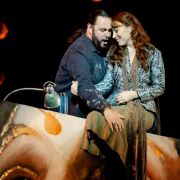
But the evening’s chief rewards came from the camaraderie and convincing interactions between the cast. Within the group of Bohemian artists, Navasard Hakobyan was the happy-go-lucky but hapless painter Marcello, impressing in his tender duet with Mimì, his despair totally credible. Owain Rowlands brought boyish spirits to the musician Schaunard, while Ross Fettes as the philosopher Colline supplied ample gravitas to his Coat Aria. Most compelling was the Portuguese tenor Carlos Cardoso as the poet Rodolfo. Notwithstanding a fast vibrato, his opening “Che gelida manina” was the real deal, his fulsome tone rising effortlessly above the orchestra in big moments and his emotional turmoil believable during Act 3 when tired of Mimì yet unable to relinquish her completely.


It’s always a joy to hear Greek soprano Alexia Voulgaridou, her voice already familiar to WNO audiences for previous roles in Il trittico and Madama Butterfly. This “delicate flower” combined the fragility of a consumptive with a purity of tone, able to melt hearts in her tender reminiscences of Act 3. Shy yet dignified, frail yet passionate, Voulgaridou’s Mimì is one of the best I’ve seen.

Elsewhere, Howard Kirk was reliably gullible as the drunken landlord Benoît (an old hand in this role), while Sofia Kirwan-Baez made for a petulant and attention-seeking Musetta. Her silvery tones were just a little underpowered, but she found vocal reserves for her waltz “Quando me’n vo”. There was no shortage of firepower from the WNO Chorus and the dozen or so children whose bright tones filled the stage.
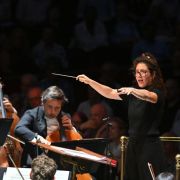
In the pit, and making her WNO conducting debut, Corinna Niemeyer drew rich sonorities from the WNO Orchestra. Once the slightly rushed opening bars were out of the way, she coaxed much illuminating detail from Puccini’s lavish score and fashioned a fluid account, always with an acute ear for balance. Altogether, this was an evening of magnificent performances above and below the stage.