With Welsh National Opera’s horizons shrinking as subsidy cuts necessitate austerity of programming and touring next season, this bracing performance of The Flying Dutchman was a powerful reminder of the extraordinary musical standards which are at risk.

Presumably in forgivable pursuit of vital funding, much emphasis was placed in the evening’s programme book on the essential ‘Welshness’ of the company. This concept extended to the setting of director Jack Furness’ Dutchman, which takes place in a post-industrial provincial Welsh port town which is down on its luck. Senta’s backstory is graphically depicted in the overture: amid howling winds and heaving seas, we witness her mother’s agonising labour. Some years (minutes) later a child Senta is seen at her mother’s hospital bed, observing her death. The child matures, running in huge sweeping circles around the stage – more of that later – and the action begins. As a mechanism to explain Senta’s infatuation with the Dutchman legend, this is a neat solution.


Alongside Elin Steele’s stripped-back sets (ships here replaced by mist and abstract backdrops), costumes are contemporary and simple. The girls of the spinning chorus are seen working on their evening wear, perhaps in some community hub, for a big night out. It probably isn’t entirely necessary or helpful to make the entire female chorus and Senta strip to their underwear on stage when donning their frocks, and some may find the choreography here grating. In these straightened circumstances, the primacy of Wagner’s music is essential. Happily, a strong cast of principals delivered compelling performances which never made the setting feel threadbare.
Rachel Nicholls’ Senta was the standout performance, crafting a musically and dramatically convincing character. Her elegant tone never once felt strained, and in the tender moments later in the opera she sang with exquisite control. Her impassioned obsession with the legend of the Dutchman was all consuming, strikingly at odds with Simon Bailey’s tormented, if circumspect, title character. Compared to Senta’s lively stage presence, Bailey was initially far more rooted in time and space, with a brooding air appropriate to his ancient character, thus making his transformation in the final act all the more powerful. His robust bass-baritone combined both maritime gristle with glimpses of vulnerability. In duetting with Daland (James Creswell), there was a touching sense of his desperation. Creswell was a hugely commanding stage presence, brilliantly gravelly in his lower register and surviving an occasional threat of strain in the highest tessitura.

The remaining principals all gave their contributions with assurance, even in the face of some unsympathetic characterisation. Leonardo Caimi (Erik), bedecked in the suit of a failing salesman, seemed to spend much of the evening with his head in his hands. His bright tenor was comfortably powerful enough to convince everyone of his hopeless anguish, so the acting occasionally felt over the top. Trystan Llŷr Griffiths’s Steersman was light and graceful in his Act 1 night-watch. Monika Sawa’s acerbic Mary was suitably maternal while trying to drag Senta back to some sense of reality, commentating on the spinning chorus with crystalline sharpness.


The WNO Chorus sang as if they weren’t sure when their next big outing might be, giving enormous power to their big set pieces. The Act 3 chorus “Steuermann, lass die Wacht!” was a thrilling moment of nautical bombast. Their blocking occasionally felt a little ungainly or uncoordinated, though this may have been a product of the company’s one-night-only relocation to Birmingham for this performance.

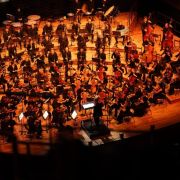
In the pit, the large WNO orchestra played with the sort of quality and sheer power one might expect from a symphony orchestra. Departing Music Director Tomáš Hanus allowed his woodwinds adequate licence to enjoy their solos, here delivered with meticulous character. The orchestral playing felt an intrinsic part of the action, vividly painting the scene in a rollicking account of the overture. The salt of the sea (or perhaps of a sweaty labour?) could almost be tasted in the air.
We came full circle, quite literally, in the opera’s final pages. While the dramatic premise to Senta’s origins story had made convincing sense, her sacrifice in Act 3 stretched credibility. Amid the unbearable tension, Senta once again returns to sprinting those great, sweeping circles around the stage, until she collapses, clutching her chest. Are we to infer that she knew she could sacrifice herself by exploiting some incipient cardiac pathology? As her hospital bed disappeared down the same mortuary corridor that her mother’s had taken a couple of hours earlier, this struck me as a clumsy ending to an otherwise dramatically strong and musically superb performance.