

New York City has been alive in recent months with the spirit of nonagenarian minimalism. Just weeks before The New York Philharmonic marks the end of official Steve Reich celebrations at Carnegie Hall, the Brooklyn Academy of Music mounted a new staging of the concert version of Philip Glass’ Einstein on the Beach. The iconic minimalist opera premiered in 1976 at the Festival d'Avignon, with visual design by Robert Wilson. It first came to BAM in 1984 with revivals in 1992 and 2012. This new production is of the concert version – about half the full opera’s five-hour run time – and retains the concept, if not the specifics, of Wilson’s overwhelm of backlighting.

In Es Devlin's artistic installation, the red and gold of the opera house disappeared as the lights went down and a single, almost blinding horizontal light rose from the stage. Slow organ music accompanied a succession of spoken numerals before the choir entered repeating more numbers in succession. Another beam appeared, making it hard to look at the stage, but generating excitement. The lights moved among unlit beams, creating intricate slightly hallucinatory shadow play. The pulsing patterns of the music, meanwhile, multiplied and folded in on the themselves. There was little action onstage. The lights were our guides.


The work showed its age at times, in its pop culture references and slightly cheesy electric organ (even if now played on a versatile, multi-voiced, contemporary keyboard). But far from a museum piece, it was alive and radiant. It could be an Olympics opening ceremony or a video arcade soundtrack. But if the first half had the hits, the second half contained the majesty. A series of extended sections moved through remarkably Baroque passages and a convincing mini concerto for sequencer and Coltrane-styled saxophone, well played by Andrew Sterman.

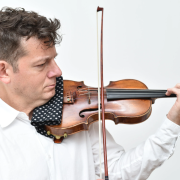
The Philip Glass Ensemble, led by longtime music director Michael Riesman, were all amplified, with a tight mix making them a sonic whole. But within the density, there were standouts: Sterman, for one, and the on-point violinist Aliayta Foon-Dancoes, who executed several solo pieces masterfully. Bass baritone Joe Chappel was wonderfully comedic in a gender-normed aria that showed its age. The Howard Gilman Opera House doesn't get the credit it deserves as one of the finest sounding rooms in the city, although the mix on this night favored the keyboards a bit heavily. The voices were (after the first few minutes, anyway) clean and present, though. In a piece so much about group precision, however, one wants perfection. Occasional straining and audible breathing among the chorus were forgivable distractions.

Much has entered the cultural landscape over the five decades since Einstein premiered: Robert Ashley's operas, the work of Laurie Anderson and Michael Gordon, rave culture, and more Glass. The appeal of his music for Koyaanisqatsi initiated a mass popularity that couldn’t have been predicted in 1976. Even the term ‘minimalism’ has come into common parlance. But Einstein on the Beach is a masterpiece of the initial wave of New York minimalism – which, of course, didn’t mean Scandinavian furniture. It wasn’t, and isn't, about being nearly empty. It's about being full of quickly shifting sameness. Composer La Monte Young once said – only partly in jest – that the appellation refers to works created with a minimal of means, as both he and Glass worked in the New York of the 1970s. But this 50th anniversary concert version was no bargain-basement production. It was spellbinding: polished and lush, mysterious and funny, and even austere.