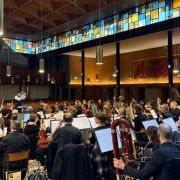
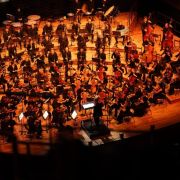
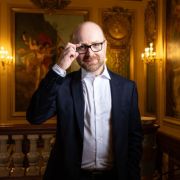
At first sight, the Église Saint-Matthieu de Colmar looks utterly unsuitable for Baroque music: you would expect the massive stone building with its 23 metre ceiling to be an acoustic cavern into which delicate instruments disappear. But you would be completely wrong: this 16th-century former Franciscan church has one of the best concert acoustics you will find – warm, limpid and never swamping the players. That’s why it’s the prime venue for the yearly Festival International de Colmar, to which artistic director Alain Altinoglu attracts a wide variety of top talent in many musical forms to this picturesque of Alsace cities.

In such a varied landscape, you’re never sure where the biggest delights are going to come from. Last night, the most sublime moment came in the Largo of Vivaldi’s Recorder Concerto in C major, RV 443, in which Lucie Horsch played the soprano recorder with such lyricism and grace as to provide a near out-of-body experience. Her first movement duet with Cecilia Bernardini, directing the B’Rock Orchestra from the violin, was joyful, and her lightning speed passagework in the third movement Allegro molto would have charmed the birds from the trees.


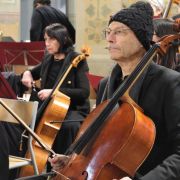
B’Rock took a moment to find their balance: in the first movements of the opening Handel Water Music Suite no. 2, the natural horns and trumpets and their accompanying oboes proved just a little to much for a modest string contingent (admittedly, the sound was magnificent). But once found – with the collegiate Horsch joining in on tenor and then soprano recorder – the balance never faltered, and their playing became as properly festive as King George I could have hoped for. Amongst the other orchestra-only pieces, Corelli’s Concerto grosso in F major, Op.6 no.6 impressed as providing a proper touch of class.

Telemann’s Concerto for Recorder in C major also showed Horsch to be excellent in dialogue with ensemble members, particularly the bassoon, delicious in the repeated falling motifs of the Andante cantabile (the first time I’ve ever seen a musician coolly take apart and reassemble their instrument mid-movement) and quicksilver in the closing Menuet, a dance that was anything but stately.
It’s not so long ago that Horsch was being written about as a “rising star”. Her star, I would argue, is now fully risen, as is that of B’Rock, founded two decades ago, in 2005.

Whether for the acoustics of Saint-Matthieu, the attractions of Colmar or just his magnetic personality, Altinoglu also attracts stars to the festival who have been fully risen for many years. The previous night, I was treated to my first ever chance to see Grigory Sokolov, who hasn’t performed in the United Kingdom since 2007, as a consequence of a visa incident – a story which demonstrates both the bone-headedness of the UK Home Office and the Russian’s ability to bear a grudge. It’s been worth the wait: Sokolov is simply the most technically perfect pianist I have ever seen. His dynamic range spans the extremes, his control of phrasing is remarkable, but what impresses most is the clarity he achieves in every note, from a single cantabile line to a dense texture. Even in the low register trills of Beethoven, where you would expect no more than a shaped and phrased rumble, you’re actually hearing every note in the trill. In the Piano Sonata no. 4, there was one passage with a voice in the middle of the texture in which the individual notes rang out like the tolling of bells, in spite of the flow of music both above and below them – a truly extraordinary effect.


So I feel churlish in confessing that for all my wonderment at the sheer quality of sound, I did not find the sonata particularly moving. That improved, however, with the Six Bagatelles, Op.126, a misnomer if ever there was one given what substantial pieces these are, where Sokolov carried me with him on Beethoven’s journey, providing surprises from time to time (the heavy accenting in no.4 being the most notable of these). And the second half Schubert Piano Sonata in B flat major, D.960, was altogether more involving. In this emotional journey, we don’t know where we’re going but we are strong, not frightened. The Scherzo was a fountain glittering in the sunlight. In the finale, we were in the safest of hands for the race to the chequered flag.
David’s stay in Colmar was funded by the Festival International de Colmar
This review was updated on 10th July to correct the year of B'Rock's foundation from 2015 to 2005.