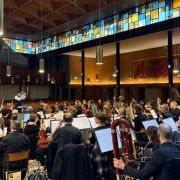
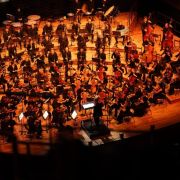
Continuing the Hallé’s association with Unsuk Chin as Featured Composer, this Thursday evening sell-out provided a golden opportunity for Chin’s Le Chant des enfants des étoiles to be premiered in its new revision. This expansive, 35-minute work is scored for huge orchestra, choir and children’s choir, with a percussion section arching all the way from behind the trumpets to behind the first violins. In this regard, and its cosmic themes, it is a neat concert programme bedfellow for Holst’s The Planets. Premiered in 2016, the 12-movement work sets poems from the Baroque to the modern age to a bold orchestral tapestry, though it was unclear exactly what had been revised for this premiere of the updated version.


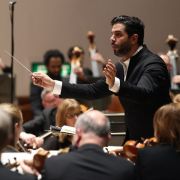
The work certainly makes huge demands on its vast choral forces, and here the Hallé Choirs sang with enormous heart. Amid the technical challenges of the music and orchestral accompaniment, though it was almost impossible to discern any details of the text here (with the exception of the superbly clear Youth Choir). The absence of printed text or projected surtitles was therefore frustrating, even if the acoustic effects conjured up from the choir stalls were often thrillingly exciting. The orchestral playing was also thunderous, most of all at the climax of Part 2, with roaring drumrolls and organ, the latter also given some virtuosic passages elsewhere. Nonetheless, with Kahchun Wong’s head frequently in the score, other choral and orchestral moments felt oddly tentative.

By Wong’s standards, his account of The Planets was a relatively safe account of an old favourite, eschewing any particular interpretative imposition on the music in favour of allowing the score to speak for itself. It was suitably rousing in its rowdier movements, but here it was the magic and mystery of the softer corners which stood out for their beauty. After the tumult of Mars, with a couple of moments of uneven ensemble, the serenity of Venus has rarely felt so exquisitely well balanced. Here the sound world conjured Ravel for its rich orchestral palette, though with details shining through like starlight, and ample space left for lovely woodwind solos. There were a couple of moments of especially elegant string phrasing in Jupiter’s famous hymn-tune, and the trombone chorales in Saturn were ravishingly rich. While Uranus felt safe rather than devilish, Neptune was hugely successful for its almost concertante feature of the celesta and bilateral choir sounds wafting in from behind both sides of the organ.


Colin Matthews’ Pluto, The Renewer, commissioned by this orchestra in 2000, made for a fun postlude. After emerging attacca amid the last bars of Neptune, the movement flurried along at breakneck speed in a rollicking 5-in-a-bar. The sense of hurtling through space on a freezing rock was unmistakeable. Matthews noted in 2000 that he suspected the movement’s dedicatee, the late Imogen Holst, would have been both “amused and dismayed” by this addition. While not for everyday use, its inclusion here felt somehow fitting rather than dismaying.