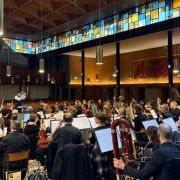
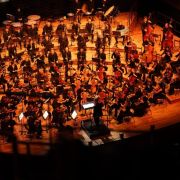
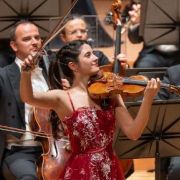
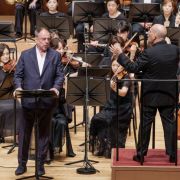
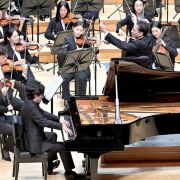
At Lotte Concert Hall, Jaap van Zweden and the Seoul Philharmonic Orchestra gave Mahler’s Sixth Symphony as an argument under pressure rather than a pageant of anguish. The evening ran on the swift side, but speed was never the point. What mattered was the conductor’s refusal to spend emotional capital early: phrases were banked, climaxes measured and the orchestra’s bright, compact sonority – strings tightly grained, brass incisive, percussion exact – was made to serve a larger line. Tragedy, here, was not declaimed. It was built.

The opening Allegro energico mattered not simply as a show of force but as the first planting of the symphony’s later logic. The march advanced with clean, unblinking purpose; the Alma theme, warmly shaped but never cushioned into safety, carried a fine crack in the line, as though tenderness already knew the terms of its defeat; one sensed that the line was being watched by the march it sought to escape. That relation between first subject and second – external pressure against private lyricism – gave the exposition its charge. In the development, cowbells registered less as pastoral respite than as a memory of distance already lost. By the coda the music had not conquered its ordeal; it had merely learned its outline.


With the Scherzo placed second, van Zweden hardened the symphony’s early trajectory. This was not Mahlerian grotesque in quotation marks. The dance was split-minded, unstable, its footing repeatedly giving way beneath it, with xylophone and timpani biting through the texture like stress fractures suddenly made audible. Even the Trio withheld comfort: not release, but a temporary clearing inside derangement. In the Andante, the Seoul strings were at their finest, spinning a close-woven legato of real beauty, though van Zweden kept sentiment on a short rein. The opening could perhaps have yielded a touch more softness; yet the gain was continuity. A cool shadow sat within the harmony, and by the time the movement’s climaxes receded, one felt less healed than prepared; silence gathering material for what the finale would expose.

That last movement proved the evening’s true point of reckoning. Van Zweden shaped the introduction as a field of fragments already carrying the memory of ruin. When the major-key gleams returned, they did not promise deliverance; they came hunted, hemmed in by the same compulsive march-profile that had shadowed the first movement. The first hammer blow stopped the breath; the second struck broader and deeper, opening a real abyss.
Yet the more telling choice came later. Van Zweden did not relax the structure to underline catastrophe, nor did he turn the aftermath into expressionist sprawl. Surface energy remained: the march-rhythm kept moving, brass and lower strings still holding the public profile of the march, as if the symphony were determined to continue under its own discipline. Inside that frame, however, the harmony darkened, weight gathered in the bass, and each return seemed to come back less as assertion than as effort. The coda was therefore neither brutal nor blank, and certainly not triumph by negative means. It carried something more difficult: a bleakness mixed with bearing. Mahler’s hero did not simply vanish; he knew exactly what had been lost.