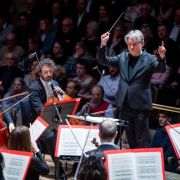
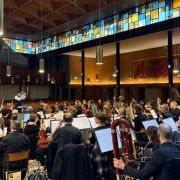
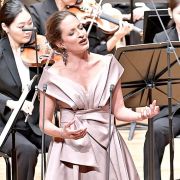
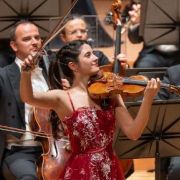
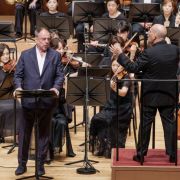
At Seoul Arts Center, Lahav Shani and the Munich Philharmonic Orchestra opened Beethoven’s Egmont Overture with deliberate breadth. The Sostenuto settled into a dark floor; the Allegro advanced as controlled public tragedy. The victory coda had brass amplitude, but ceremony outweighed the stored danger that should ignite Beethoven’s release.

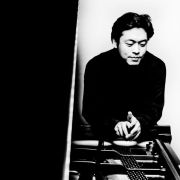
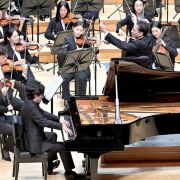
Prokofiev’s Piano Concerto no. 2 in G minor with Seong-Jin Cho was the evening’s true test of idea against execution. Cho’s premise was compelling: to reconcile Russian gravitational attack and monumental construction with clarity, colour and contrapuntal legibility. The opening Andantino–Allegretto unfolded in a roomier, loosened pulse. The first piano monologue came cool and private; the left hand breathed without mechanical rigidity, while the cantabile carried a faint Rachmaninov undertone, keeping clear of nostalgia.


That same spacious frame, however, exposed the central cadenza. Cho’s design was clear: voices separated, sonorities accumulated, the climb aimed carefully toward the colossal. Yet the long-breathed architectural pacing did not quite become self-sustaining. Held in this broad pulse, the cadenza proceeded in finely profiled paragraphs, the joins still audible. At the crucial tightening, pressure seemed carried uphill by the pianist instead of generated by the music’s own compression. The result was imposing but earthbound, its structural stamina exposed. What followed persuaded more strongly: the brass re-entered with fatal force and the coda allowed the opening monologue to return as a final ember, making tragic circularity audible.
The Scherzo sat on firmer ground. Cho’s unbroken semiquavers had clear vector, though the orchestra’s interjections lacked the knife-edge needed to tear into the piano’s surface. The Intermezzo became a study in pressure: measured pedalling, weight in the bass and charged rests turned the music into a psychological march. The grotesque did not flash with maximum acid, yet the climate of constriction and fear was sustained. The Allegro tempestoso finale began with rough animal force. Its central lament was beautiful without quite opening a dark Russian interior. From the Più mosso marking onwards, weight and clarity worked together. Cho’s Prokofiev was like a young wine just uncorked: body, bouquet and structure already present, still needing time to breathe.

After the interval, Shani took Brahms’ Symphony no. 4 in E minor in broad tempi, with a sober sense of mass rather than immediate heat. The Allegro non troppo was carefully built, with violins lean but firm and lower strings answering in dark human grain. Shani seemed intent on letting orchestral weight gather by degrees, not pressing it into one saturated block. The gain was poise; the cost, temperature. In darker brass-and-low-string colour-fields, the sonorities stood close without fully binding. The Andante moderato moved with processional dignity. Woodwinds were cleanly placed and sentiment kept on a short rein. Still, the pizzicati needed more spring and the string cantabile spoke as cultivated song where Brahms asks feeling to gather at the edge of confession. The line breathed, but its wound remained partly civilised.


The Allegro giocoso showed the same thinking under greater stress. Shani gave the movement a firm underpinning, making the C major blaze grow from bass weight and timpani rather than surface glitter. But his broadly measured conception softened some shocks; transitions organised themselves a fraction late, and brass-string verticals lacked the last collective bite. The Allegro energico e passionato finale made the balance of virtues and limits clearest. A blurred trombone attack weakened the passacaglia’s first statement, yet Shani recovered by tightening the variation chain instead of inflating drama. The flute solo was exceptional: plain, solitary, long-breathed, without perfume. The closing pages held stern shape and considerable weight, registering less as catastrophe than as a grave summation.