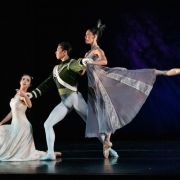
If Rudolf Nureyev were still around, he might learn a thing or two from Aleisha Walker. Their choreography shared the stage in Week 1 of this summer’s Joyce Theater Ballet Festival, curated by the celebrated Misty Copeland. Walker’s world premiere for five dancers from American Ballet Theatre and Dance Theatre of Harlem followed the balcony scene from Nureyev’s 1977 Romeo & Juliet, the juxtaposition throwing Walker’s gifts into sharp relief.

She makes choreography breathe, tailoring it to each dancer’s strengths and personality – Delaney Washington’s whacking extensions, her own angular attack – while demanding stylistic unity on a technical knife edge. Madison Brown was the piece’s magnetic center: serene, joyful, darting, mischievous as the others whirled around her. The piece soared on Joby Talbot’s score.
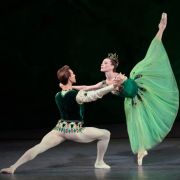
It's difficult enough to pull off the iconic balcony-at-dusk scene from Romeo & Juliet in isolation – doubly so without a balcony, or dusk. A few projections might at least have given the luminous Sae Eun Park something to gaze at soulfully besides a blank backdrop as she drifted on and offstage. But there’s no easy fix for Nureyev’s hectic choreography, even on the bodies of two Paris Opera étoiles. His obsession with ronds de jambe and feet beating at the knee extinguished the teenage yearning Prokofiev so poignantly evokes. Guillaume Diop, bounding like a gazelle, his eyes widening at the sight of Park, made an engaging Romeo – if a rough partner, not always keeping her centered in supported pirouettes and, at one point, hefting her onto his shoulder as unceremoniously as the day’s harvest.


Newly retired from American Ballet Theatre, Copeland has embraced the challenge of cultivating new ballet audiences while bringing fresh voices to the stage. This program centers Black, brown and queer artists – both established names and rising ones – reflecting Copeland’s conviction that “ballet’s future can hold so many different voices and identities and aesthetics and experiences, and that it should be as rich as our world.”
Three solo turns struck gold in Week 1, none more so than Victor Abreu’s revelatory turn in José Limón’s 1961 Sonata for Two Cellos. The newly minted New York City Ballet soloist is only the third dancer to perform the role, after Limón himself and Desmond Richardson, ABT's first Black male principal dancer.

He bowed solemnly to cellists Sahara von Hattenberger and Titilayo Ayangade before striding off with brooding purpose. The cellos grumbled and soared, sending him twisting, lunging, thrusting, leaping. His dramatic gestures sometimes hinted at Thai or Indian dance; other times they turned elegiac, as two cupped hands at his waist recalled a long-abandoned sheathed blade, the echo of an old vigilance. Abreu cast a mistrustful glance at the cellists before they released him from his exertions with a satisfied nod.
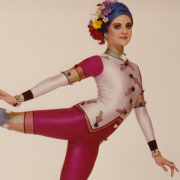
Where Sonata was a slow burn, Bob Fosse’s Percussion IV ignited like a Roman candle, detonated by Shota Miyoshi of Hubbard Street Dance to a score suggesting a major industrial accident. Taylor Stanley, whose collaborations with Kyle Abraham date back to 2018’s The Runaway at City Ballet, literally glittered in Abraham’s Show Pony, encased in a gold catsuit that looked spray-painted on. As if a cyborg programmed to keep the masses in thrall with their grinding, high-kicking routine suddenly went rogue, lapsing into delicate, flirty, insecure – almost human – gestures before a shrill whistle snapped them back into line. Stanley brought singular virtuosity to the role, a modern Golden Idol from the exoticized India of La Bayadère.


Duets on the other hand quickly lost steam after Dwight Rhoden’s ecstatic Ave Maria, danced by the splendid Joe González and April Watson of Complexions Contemporary Ballet, poured into royal-purple velvet briefs (him) and leotard (her), every sinew quivering. The two-word invocation of the Virgin Mary, chanted throughout the quasi-Renaissance hymn, made an ironic backdrop to irreverent gymnastics executed at breakneck speed, crotches flashing with the regularity of traffic lights.
González gripped Watson’s joints in rapid-fire succession, though she seemed perfectly capable of executing the intricate maneuvers unaided. Watching the pas de deux was like watching fighter jets swoop onto the flight deck of an aircraft carrier and catch the arresting wire perfectly, every time.

Houston Thomas revived a same-sex duet from his 2025 ballet Young Lovers, danced by Joe González and Aeron Buchanan. Bookended by a slow dance, the choreography echoed Rhoden’s fleet, full-throttle partnering, though with less supple legato. Ingrid Silva, a pillar of Dance Theatre of Harlem for nearly two decades, showcased Renan Cerdeiro and Elias Re’s considerable physical gifts in a playful duet sabotaged by an insipid score.
The program leaned heavily toward showiness, the American penchant for impetuosity – for kicking doors down, flinging ankles to ears – and the American need for speed. By Week 2, a little stillness wouldn’t kill anyone.