While few who work in the performing arts will look back on the pandemic with fondness, it did allow time for creative productivity. For Carlo Rizzi, it afforded him the opportunity to arrange two of Puccini’s operas, Tosca and Madama Butterfly, into symphonic suites. Rizzi had a point to prove: that Puccini’s music is not only a collection of great tunes over some nondescript background structure, but the background structure is great music in itself. As a loose parallel, we know that without Gounod’s tune for Ave Maria we can still enjoy Bach’s Prelude in C in its own right. But can the same be said for “Nessun dorma”?

The answer is yes. Indeed, presenting the music in a symphonic setting without the opera encourages closer listening. I have never, for example, listened out for the bassoon in Tosca, yet heard it clearly in the suite. And while there is no staging, set design, lighting effects, costumes or acting to drive the narratives forward, the music still conveys tremendous tension, drama, romance and passion. Rizzi’s arrangements present Puccini’s music without adding or mutating instrumentation. The vocal lines are not reassigned to the oboe, neither were the cellos of the City of Birmingham Symphony Orchestra asked to stand in for the horns. Nor does he present the works as a retelling of the narratives, but as suites indicative of the emotions that the operas stir. I felt, in a way, that these were almost alternative overtures in their effect, though rather extended ones at 20 and 18 minutes respectively.


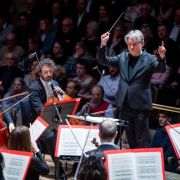
Rizzi conducted the CBSO with vigour and power, unleashing the dynamic extremes to drive home an emotive intensity true to Puccini’s spirit. These were very enjoyable arrangements and the point Rizzi wanted to make about Puccini’s music and orchestration was clearly proven. That said, they whetted my appetite for the operas rather than satisfied it.
The concert programme, all ostensibly connected in one way or another to Rome, was divided between these suites and two works by Ottorino Respighi. The running order staggered the works of the two composers, and I felt it might have been a better fit to put the two Puccini arrangements consecutively, leaving the second half to Respighi. The melancholy of Respighi’s Il tramonto was something of an anticlimax in the wake of Tosca, though admirably interpreted and performed by Fleur Barron. It might have worked better, to my sensibilities, as a warm-up to The Pines of Rome rather than a follow on from Puccini.
It is understandable, however, that Rizzi did not want to present his two symphonic suites one immediately after the other, and with Butterfly beginning the second half, we moved from Nagasaki to the parks of Rome underneath Respighi’s rustling Pini di Roma. Whereas Puccini’s orchestrations convey an aural chiaroscuro effect of drama and power, Respighi’s are more nuanced and musically descriptive, and Rizzi was able to bring the images alive. One could feel the warmth of sunlight in the park, sway with the breeze as it shifted the trees, stand in awe at the foot of the ruins of Rome’s mighty empire. Although descriptive in essence, this music is just as powerful as the drama conjured by Puccini, and the CBSO, replete with off-stage brass chorale, concluded with a superb finale that raised the hairs on my neck.