When Francis Poulenc described his Concerto for Two Pianos and Orchestra as “cheerful and straightforward”, he was surely referring to the mood of a piece first performed with his childhood friend, rather than its considerable technical demands. Whatever he meant, he’d have been delighted with the idea of the dual Dutch phenomena that are pianist brothers Lucas and Arthur Jussen who made their BBC Proms debut on Sunday night.

They are certainly entertainers. With blond quiffs, big smiles and matching blue suits, the Jussens were welcomed enthusiastically to the podium, before ripping into the octave leap that begins the Allegro ma non troppo (one person’s ‘not too much’ is another’s ‘not quite enough’), grinning at each other across the strings of the two open pianos. It’s easy to see the dynamics of the sibling relationship writ large: Lucas (b.1993) bounced through a dazzling technical display while Arthur (b.1996) leaned heavily into his very busy left hand and seemed to be egging his brother on to go faster.


Brilliant communicators between themselves, the Jussens played – and I mean really played – with the orchestra, exchanging glances, signalling to individual players as they shared or swapped phrases. Poulenc wrote this concerto in 1932 for Princess Edmond de Polignac whose Paris salon was the watering hole of the French avant garde. From the drama of the opening movement’s silent movie car-chase music – those descending chromatic scales – to the cool, refreshing glassiness of the molto cantabile with its twinkly, gamelan-style figures, and the Mozartian repetition of that same car-chase in slow motion (only Poulenc) the Jussens brought to the Royal Albert Hall an irrepressible joie de vivre and daring that its composer would have revelled in.
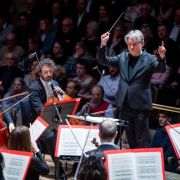
None of which would have been possible in this most variable of acoustics without the incredible control of the City of Birmingham Symphony Orchestra’s Music Director, Kazuki Yamada. The concert began with Poulenc’s Sinfonietta, commissioned for the BBC Third Programme in 1947 and only now making its first outing to the Proms. Yamada, whose mesmerising gestural precision is a whole study in itself, made a lightning strike of the opening bar. What followed was absolutely electric: éclat, dazzling articulation, that very Poulenc sense of wistful melancholy as well as the rumbling heart-on-sleeve pride of the Vous n’aurez pas… (the theme that first appears disguised as an ‘Amorous Lion’ in occupied Paris in 1942 and reappears, triumphant – with a thumb up the nose – in the Sinfonietta of 1947). As an ensemble and as soloists, the CBSO under Yamada played at the top of their game.


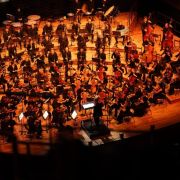
John Adams’ epic Harmonium in the second half saw an expanded CBSO joined by the considerable forces of the City of Birmingham Symphony Chorus. In this hall, with such vast distances between singers, players and conductor, there’s a danger this piece with all its intricate cellular repetitions and the very palpable sense that everyone is counting as if their life depended on it could turn into a monster. Under the control of Yamada it was a thriving organism, despite moments when the glass-edge clarity of the first half softened a little. The CBSO Chorus delivered the poetry of Emily Dickinson and John Donne with admirable precision so that most of the text was audible. However, it may be time for the Proms to admit that surtitles of some kind would have allowed more of the audience to engage fully with Adams’ vision.