The version presented this Christmas season for the Ballet de l’Opéra National de Bordeaux is a distinctive Romeo and Juliet conceived by Massimo Moricone, who personally staged this French première of his 1991 production for Northern Ballet (Leeds), created in collaboration with Christopher Gable. While it shares with most renditions of the world’s most famous love story the aim of heightened expressiveness and pathos, it also stands out for its deliberate concision, justified by the repetitions in Prokofiev’s score and by the intention to go straight to the action.

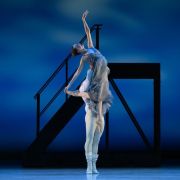
Act 1 (like the two that follow) opens with a thunderstorm rendered through recorded sound and lighting. Juliet (Vanessa Feuillatte) and Romeo (Oleg Rogachev) appear beneath a broken arch before being drawn to opposite sides of the stage – a sombre premonition of the tragedy to come, echoed by the barely legible inscription on the backdrop “amor vincit omnia”, its decay making it read as a bitter inversion of Ovid’s dictum.
This single set piece, only slightly reconfigured, frames all three acts and lends the production its rapid momentum. When the festive ensemble floods the stage, Romeo’s exchanges with Mercutio and Benvolio – brilliantly danced by Sachiya Takata and Diego Lima – burst into athletic jumps, cartwheels, dynamic lifts and floor slides. In a flash, we are swept into the Capulet ball, where the chromatic dominance of red in lighting and costume saturates the stage.


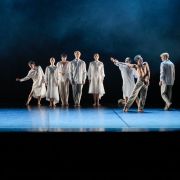
Juliet enters with four friends, all in white, who take their space in the choreography and, unusually, dance with the Capulet men. Her barely contained lyrical stretches, betraying desire for the mysterious man just met, lead straight into the balcony pas de deux, which erupts in passion: not the gradual process of mutual discovery or Juliet’s gentle awakening to love, but a wild, immediate outpouring. At the end, left alone on her knees at centre stage, Juliet offers a striking image of vulnerability and upheaval, mirroring the audience – suspended in that moment of breathless stillness after the ardour of the dance.

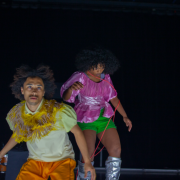
Act 2 explodes with colour and force, with the original choice of having peasants and the nurse (a vivid Anna Fazzi) on pointe in humorous sketches that the audience clearly enjoys. Romeo enters still imbued with Juliet’s charm and hopelessly in love. We are then catapulted into the church for the wedding, ending with the tambourine dance, performed by the Capulets as obnoxious felines, taunting and provoking the Montagues. This is a striking choice in a version that aims for essentiality, especially since the number is not crucial to the narrative and is absent, for instance, in MacMillan's version.
In seconds, we shift from joy and playful banter to the deaths of Mercutio and Tybalt – the latter shaped with elegant menace by Kylian Tilagone. Juliet, usually absent here, witnesses the tragedy and breaks into desperate tears. The act closes with a downpour falling across the entire stage.

Act 3 is a moment of psychological clarity, revealing Juliet’s nature and her resistance to her parents’ particularly violent, degrading and oppressive spirit – Lord Capulet even attempting physical violence against her. All her interactions, with both her parents and the priest, are heightened to an almost melodramatic intensity; everything feels amplified for her, and she indulges in scenes of complete despair, appearing at times like a difficult child.
Alone in her room, Juliet – like a modern teenager – cries, collapses and dances by herself. In an instant, a dark awareness emerges on her face: the joyful, spirited girl gives way to a woman taking shape before our eyes, with a flicker of malevolent realisation and treacherous intent in her gaze. An especially interesting choice is the placement of the mandolin dance at this point: four couples scatter sparkling red rose petals around Juliet’s body as she is prepared for her wedding, lending a macabre, contrasting tone to the entire scene.


This is indeed an intense, dense and expressionist rendering of the ballet, with an accelerated dramaturgical progression where we are accustomed to processing the tragedy more slowly and with a fuller delineation of character. Sword-fighting is reduced to a minimum, with batons and knives creating closer, more visceral encounters, while fireballs of red cloth tossed across the stage add a highly theatrical charge. Cries become an explicit vehicle of grief, and blood is used with striking effect – on Mercutio’s handkerchief, on Tybalt’s face, and on Lady Capulet’s hands as she touches her dead nephew, stepping forward in a simple red tunic rather than the pompous gown we usually see.

The work offers an intriguing blend in which the crystalline French classical style meets the expressive intensity of the British tradition, and it is danced by exceptional interpreters: Feuillatte and Rogachev, in particular, shape a palpable and finely modulated passion. Yet the production gives the non-protagonists limited room to shine, and one leaves the theatre wishing to have seen even more of their talent.
Elsa’s travel was funded by the Ballet de l’Opéra National de Bordeaux