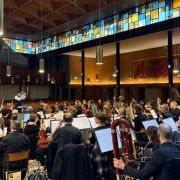
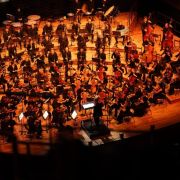
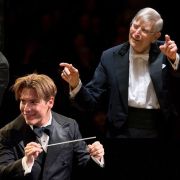
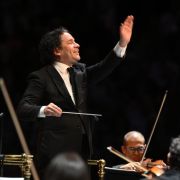
Sometimes an encore is considerably more than a parting gift from appreciative performers to a delighted audience. That proved to be the case when Esa-Pekka Salonen pressed the button which ignited Stravinsky’s Galop to round off his concert at the Royal Albert Hall. That brief explosion, and the fall-out from it, seemed to encapsulate the essence of the performances that Salonen had conducted, consisting of three great works from the first half of the 20th century: Stravinsky’s Symphony in Three Movements; Berg’s Violin Concerto; and Bartók’s Concerto for Orchestra. The active ingredients which characterised his reading of all four pieces included razor-sharp rhythmic articulation, sonorities reminiscent of shimmering silk, glowing embers and dazzle of the sun at midday, and hints of lyrical arabesques.


Salonen’s co-creators of those performances comprised an ensemble of youthful talent drawn from the Juilliard Orchestra and the Royal Academy of Music Symphony Orchestra. The partnership of players from those two august institutions is part of a world-wide initiative which has been bearing sumptuous fruit for 25 years, and, on this showing, is a project that thrives on excellence. Although the shadow of death hangs over the three programmed pieces, the playing wasn’t dominated by overt mournfulness. In the Stravinsky, for example, the abiding image was not the spectre of war, as the composer averred, but of an expectation of joyful deliverance depicted in the dancing of the strings and the piano; the sound of that was just delicious.

In the Bartók, the composer’s straightened circumstances and his impending demise is not inscribed in the fabric of the work, but some interpretations are tempted to look for clues. Not so with Salonen; his reading directed attention to the composer’s skill as a creator of original sonorities given life through masterful orchestration. The voices of the wind and brass were alive with convivial camaraderie, particularly in the second movement where the players had a ball. There was also that very over-ripe raspberry proffered by one of the trombones. It would be interesting to know how Shostakovich reacted to it. Throughout the piece the strings were on top form and in the finale really did lift the spirits.


For the Berg, Vilde Frang and her 1734 Guarneri del Gesù gave a reading that might easily be described as depicting death and transfiguration. The bleak, empty intervals of the opening phrases could not but remind us of the death of Manon Gropius; however, the rich and detailed tapestry that the composer fashioned has as its central image the transformation of sorrow into rapture, which was superbly captured by the performance. There was an engaging chemistry between soloist and conductor, and between soloist and the strings, with Frang seemingly drawing strands of skein from the leader. In the closing phrases the very fine playing of the orchestra gave the soloist the comfort necessary to glimpse the peak of Parnassus where Berg must surely reside.