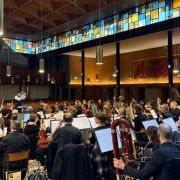
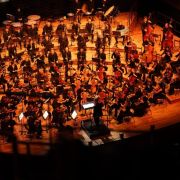
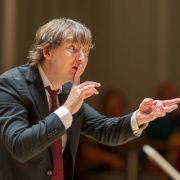
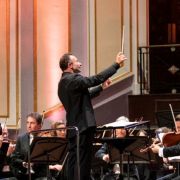
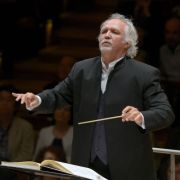
If you’ve attended a season opener from the Royal Scottish National Orchestra any year since 2018, then the chances are that you’ll have heard a Mahler symphony conducted by Thomas Søndergård. That’s what 2026 offered too, but after this there will be no more, because this concert inaugurated Søndergård’s final season as the RSNO's Music Director. After this Mahler 6, he’ll have conducted the full cycle, except for the Eighth, which isn’t scheduled for this season. Anyone taking bets on the closing concert of next summer’s Edinburgh International Festival?

This concert was a reminder of what has worked so well in his seasons-long Mahler cycle, and of what Scottish audiences will lose when he moves on. There was punch, terrific heft, heart-swellingly beautiful orchestral playing and, above all, a rock-solid sense of direction from the podium. Søndergård paced the opening movement relatively slowly, but the orchestra met him with some terrific Schwung from the strings, who bit vigorously into every bar of the opening march, and lyrical poignancy from the wind chorale that followed the timpani motif. Even the vast finale, which has a tendency to sprawl, had a sense of transparency to its hulking scale, and there was distinctive colouring to its various episodes so that it unfolded like a series of sequences in a narrative.


Søndergård shaped that final movement with tremendous certainty, pacing it like a desperate, fatally repeating cycle of expansion and collapse that intensified as it developed, reaching white-hot intensity by the final climax. Tellingly, the first hammer blow was effective, but the second (and last) unleashed mayhem in the orchestra, a sign of the tightening screw, and the final collapse was total when it eventually arrived. The preceding Scherzo – here placed third – carried just as much punch as the opening movement, while the Andante contained gently beauteous strings and a sensational series of legato solos from principal horn Amadea Dazeley-Gaist.

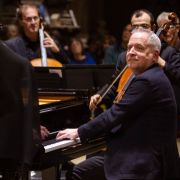
Before Mahler’s epic sprawl, pianist Alexander Malofeev joined the orchestra for Rachmaninov’s Fourth Piano Concerto. It may be the least popular of the composer’s concertos, but nobody appears to have told the RNSO that, because they lavished attention on it and brought its melodies to vivid, pulsating life. The strings, in particular, sounded magnificently full in their sweep towards the end of the first movement, and they provided an irresistible blanket of warmth in the second. Søndergård conducted with a welcome lightness of touch throughout, even bringing out some of the jazzy subtexts of the finale, with bursts of lyrical beauty to sit alongside the keyboard’s fireworks.
Malofeev played the solo line with grace and ease that bordered on nonchalance, bringing understated expansiveness to the opening chords, playing the melody of the slow movement with pinprick precision against the warm breath of the strings. His playing in the razor-sharp finale verged on the devilish, with a nod and a wink to take us across the finishing line of the finale.


Unfortunately, he threw it all away in a badly judged encore, imposed on an audience whose applause wasn’t much more than grateful. Purcell’s Ground in C minor is a party piece of his, but its miniature lines felt a little silly after Rachmaninov’s mountain peaks, completely deflating the energetic afterglow of the concerto.