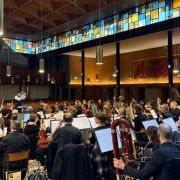
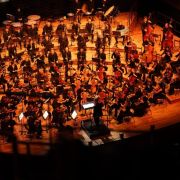
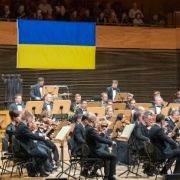
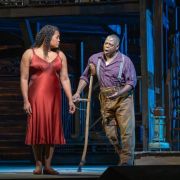
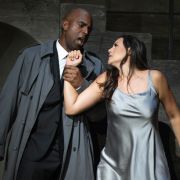
I suspect that Richarrd Strauss’ 1928 opera Die ägyptische Helena (The Egyptian Helen) will never enter the repertoire with the status of ‘overlooked masterpiece’, but Bard Summerscape’s new production, directed by Christian Räth and conducted by Leon Botstein makes a good case for a revival nonetheless. With a plot as – or more – convoluted than Die Frau ohne Schatten, (Hugo von Hofmannsthal again the librettist) but with more mythology and cloudy symbolism and less gloriously redemptive warm music, it takes patience to realize that the whole opera is about marriage and fidelity.

The ‘Helena’, of course, is ‘of Troy’, although seen through the lens of the play Helen by Euripides. Here, Helen has never quite got to Troy. Rather the gods whisked her off to Egypt to Aithra’s palace to keep her safe and substitute a doppelganger, or phantasm, to accompany Paris, with whom Helen had betrayed her husband, Menelaus. After the war, when this opera takes place, with the sorceress Aithra encouraging her and restoring her beauty, Aithra conjures up a storm at sea (with Elaine J McCarthy’s vivid projections on the stage’s back wall) and Menelaus and the ‘substitute Helen’ wind up at her palace, thoroughly confused, which is how he spends most of the opera.


Eventually he finds the true Helen and they are reconciled and reunited, with much help from Aithra, who slips them both mickeys, not to mention transporting them to a lovely oasis with the help of her elves. Oh yes – there’s a character called The Omniscient Seashell who advises Aithra. Hofmanstahl’s original notion was for a comic opera; that seems to have been scuttled and replaced with a phantasmagoric exegesis on forgiveness and reconciliation. Hofmanstahl actually thought this his best libretto. One man’s opinion. Every time the opera seems to hit on an emotional truth, magic and teleporting remove the heat and the audience remains as baffled as Menelaus.

Bard and Botstein offer a splendid show on every level. The music is full throttle Strauss, prodigious and sumptuous, filled with colorful orchestration and with occasional dips into intimate, almost chamber-like passages. The roles of Helen and Menelaus are brutal, even by Strauss’ standards. High, loud and lengthy, singing mostly as if their lives depended on it, their Act 1 duet is almost Tristan-like in its intensity and ends on a high C for both. Helena’s ravishing second act opening scene, “Zweite Brautnacht” (Second Wedding Night) contains precisely the sort of soaring soprano vocal line that enchants through the composer’s greatest music. Would that there were more such moments. The couple’s last act duet is almost equally rapturous. Hailey Clark’s Helena was grand-voiced and attractive, expressing her character’s mood changes vividly. Dramatic tenor John Matthew Myers amazed with his stamina, handsome, huge tone and ability to make Menelaus vaguely sympathetic in his skepticism at the whole situation.

The third main character is Aithra, who, in Christian Räth's vision, is the director of all the intrigue and acts as Helen’s sort of fairy godmother. Presented at first as a tired housewife at the dining room table (Act 1 is given a film noir scenario), awaiting her husband’s return, later presenting herself as a trickster and manipulator. The role is high and light, with welcome coloratura, but also with gravitas when she is in duet with Menelaus acting as Helena. (Confused yet?) And remember, she’s the one who invented the alternate Helen; she’s actually jealous of the real Helen.


When Act 2 starts, we’ve all been transported to an oasis at the foot of the Atlas Mountains with paparazzi invasively taking photos and surrounding Helen. The scenery now (by Christian Räth and Daniel Unger) offers a sensuous moonscape bathed in silver. Menelaus awakens, thinking the Helen next to him is the phantom; fractured mirrors add to the weirdness. The Prince of the realm, Altair, played with force and scary charisma by the impressive baritone Blake Denson, is smitten by Helen. But so is his son, Da-Ud, in the person of tenor Shawn Roth, whom the loony Menelaus mistakes for Paris; Altair sends them off to a hunt and Menelaus kills Da-Ud. After even more confusion, Menelaus drinks a potion of remembrance, and he is reunited with Helen. The opera ends with Aithra dancing under lovely falling snow. Deborah Nansteel’s dark-hued mezzo was clear and true as the Omniscient Seashell.
I realized at the end that attempting to decode Hofmanstahl’s text and Räth’s direction was not the point and concluded by just giving in to the splendid performance, Botstein’s sensitive leadership and some truly great singing. There’s plenty of food at this BBQ and enough of it is delicious. After all, if we can believe that Azucena tossed the wrong baby into the fire, we’re pretty much up for anything.