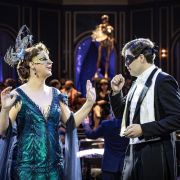
Where does music come from? What is theatre for? What are we doing when we make things? All three are questions there isn’t always time to think too hard about if you’re busy making theatre and directing the operas of Philip Glass. Or if you are Philip Glass. Seven years after its world premiere at the Manchester International Festival, Factory International and Improbable Theatre have brought the extraordinary Tao of Glass to the West End's @sohoplace, and not a moment too soon. Profoundly moving, it’s an ingenious, playful hybrid of philosophical memoir and musical meditation that explores the relationship between creativity and consciousness, the mysterious journey of creative ideas and the deep emotional, spiritual confluence that music has the unique power to access.

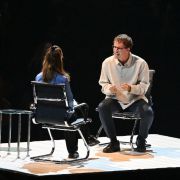
Beginning essentially as a love letter to theatre, in which Phelim McDermott name checks a number of ‘theatrical ghosts’, the narrative meanders gently through McDermott’s teenage obsession with Glass’ music, his fascination with the work of Maurice Sendak, the plan to collaborate with the two of them on a show which never happens, to the gentle unfolding of dream that is the basis of the show we are watching now: an intimate, joyful, tender collaboration between McDermott and Glass. Inspired by Taoism and Arnold Mindell’s theory of consensus reality, dreamland and essence, being the three levels in a ‘cone’ of human experience , this fascinating interplay of ideas and images becomes itself an expression of what creativity might be. The creative act is inherently uncertain and therein lies its beautiful mystery: there’s nothing makes us more human than trying to show each other what’s in our heads, as McDermott finds out when he lies on the floor in a New York rehearsal room with his eyes closed and Glass, sitting down at the piano, says simply “I’ll try to reach you.”


Up to this point, Glass’ music has been the river running throughout. Performed with great tenderness and sensitivity by a small ensemble of piano, violin, clarinet and percussion, the repeated arpeggios, climbing duplets and cyclical modulations move us through time, memory and the elusive currents of meaning as McDermott’s story unfolds. But listen carefully and there are surprises: a remembered session in a floatation tank is accompanied by a metronome, a reminder that, despite how it can make us feel, music is made of passing time.
Puppets made from newspaper were a feature of a previous collaboration, Glass’ opera Satyagraha. Here they are made from giant sheets of translucent manuscript paper, skilfully animated by a trio of puppeteers. As the sheets are formed into characters or drift off, like ideas that fall away, the rustling is integral to an inclusive soundscape that weaves ambient and recorded sound together with the live score, itself a collaboration between Glass, Sound Designer Giles Thomas and Chris Vatalaro, directing from the percussion. The magical conduit between image and music is deftly expressed as shapes shift on Fly Davis’ revolve stage: a simple window-ledge kitchen becomes the New York skyline, and wooden spoons metal grill rack, whisk and kettle all become musical instruments, their individual sounds the gentle pull on the thread of memory as time’s wheel keeps turning.

Essentially it’s a work of art about making art. If that sounds a bit too meta for you, McDermott has got there first with some disarmingly self-aware observations about the process that brought him here and the fact that Glass’ repetitive music might not be for everyone. “I’ve bored Philip Glass!” he says, horrified and awed, as he recounts the composer’s initial somnolent response to the idea of a show featuring Taoist puppetry, a man trapped in a cupboard and the Rig Veda. There’s also a cautionary tale about a very expensive coffee table and a bravura act of theatrical ventriloquism inside an exploding shed made of sellotape.


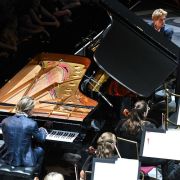
McDermott’s voice conveys an irresistible sense of childlike wonder throughout, but he won’t be offended to read that it’s when he stops talking that we reach the heart of what this piece is all about. As McDermott lies down with his eyes closed, a self-playing Steinway picks out note for note the very same musical line that Glass laid down for his friend and collaborator back in that New York rehearsal room when he said “I’ll try to reach you.” As the solo line is joined and filled out by the ensemble, the three concentric circles of the set flow up and down, in and out of each other, and we find ourselves happily adrift in this fugitive and ever-running river.