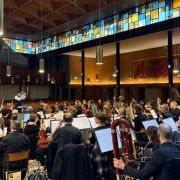
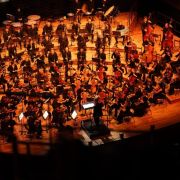
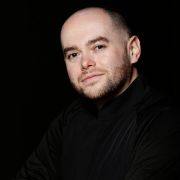
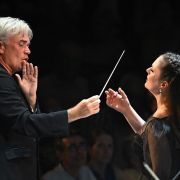
This year marks the 40th anniversary of the founding of the Orchestra of the Age of Enlightenment. In the 2020s, with the era of the podium dictators largely over, the idea of a player-led ensemble seems less revolutionary; in the 1980s it was still quite something. Over the last four decades, the OAE has become woven into London’s classical music fabric – it is now part of our establishment. This concert should have seen the OAE at its best; a bumper Mozart evening featuring the last three of his symphonies under Robin Ticciati, whose work at Glyndebourne, particularly in Wagner, has been commendable.


Alas, this was an evening of two halves. The symphonies were taken sequentially, so we began with Symphony no. 39 in E flat major. The first two movements were ponderous; no buoyancy or lightness, though the tempi themselves were not unduly slow. The orchestra seemed to struggle to find its feet; string attack lacked pinpoint unity and the horns seemed patchy. The Menuetto was graceful – lightness at last – with sway to the violins, and then the fourth movement, paced about right, with woodwinds – the heroes of the concert – beautifully fluttering over the strings. Horns were still a little diffident here, but sounded cleaner.
Spirits rose for the opening to the first movement of Symphony no. 40 in G minor, which was sinuous and flowing, the opposite of the turgidity of the previous piece, with fine woodwinds, particularly from flautist Lisa Beznosiuk. However, as we moved into the Andante the tone shifted and an air of melodrama permeated; Ticciati seemed to draw a sound of foreboding from the strings that seemed faintly ludicrous. The heaviness of the 39th bled back into the fourth movement, lightened only by the woodwinds.


After the interval, the Jupiter saw a stronger performance, though there were still one or two errant notes across the sections. Pacing was keen and there was a nimbleness to the strings which seemed to have greater coherency. Ticciati brought out the Vivace element of the first movement, the brass neat and precise against whirling strings and fragrant woodwinds. The second movement again saw delicacy from the flute, while the violins had an impulse that pushed us forward, into a heady third movement. Humour too in the fourth movement, and a sense of communication among the sections. Adrian Bending’s contributions on the timpani both here and in the earlier 39th stood out. An enjoyable Jupiter then, which went some way to redeeming a disappointing first half.