Whenever a Wagner opera is on the programme at the Salzburg Easter Festival, it’s usually the cast that offers the USP which lends the performance its exclusive character: a star of the opera world singing a role for the first time in Salzburg, or making a long-awaited role debut. Anja Harteros’ first – and only – Sieglinde, Jonas Kaufmann’s eagerly awaited Tannhäuser and Georg Zeppenfeld’s role debut as Hans Sachs, for instance, were Salzburg highlights that even the Bayreuth Festival could rarely offer, for which the cultured audience is willing to part with a little more cash in the way of opera tickets.

This year’s Rheingold boasts no fewer than two such unique selling points: firstly, the renowned Lieder singer Christian Gerhaher performing what is likely to be his only Wotan in Salzburg; secondly, the Berliner Philharmoniker returning to the Salzach after 13 years’ absence. Under the baton of their Principal Conductor, Kirill Petrenko, the Berliners are currently more in demand than any other orchestra in the world. The fact that he seems downright obsessed with Wagner’s music dramas was impressively evident in his conducting: with an extremely compact, dense and finely balanced sound, as well as brisk tempi, he and the orchestra revealed every motivic nuance and completely captivated the Festival audience, who sat on the edge of their seats in suspense. With sudden dynamic shifts in tight unison, Petrenko seemed to master the score, thereby producing an exceptional orchestral performance of a calibre that appears possible only with the Berlin Phil.

Gerhaher succeeded in portraying Wotan, father of the gods, as a unique, self-contained work of art. His was a Wotan far removed from any of Wagner’s authoritarian bellowing: a reflective, contemplative ruler, mindful of every syllable, who exercises influence and leadership in the realm of the gods not through mere displays of power, but from an intellectual sense of self. With the flawless technique of a truly great Lieder singer, Gerhaher possessed such absolute role awareness that his Wotan was equally convincing in perfect style, even if his voice lacked volume.

Gerhaher blended perfectly into the ensemble around him, on which the Easter Festival had taken a considerable risk. Gathered around the Lieder singer was a cast consisting almost exclusively of lesser-known singers, most of whom have little experience in Wagner, and who were either making their role debuts or had only previously performed them on smaller opera stages. This gamble, however, proved to be a masterstroke. Without exception, every one of the numerous roles in Rheingold was excellently performed, far exceeding the basic requirements of the parts and thus worthy of a festival production.

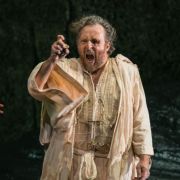
Leigh Melrose’s Alberich was, thanks to his constant presence (even in video projections), almost the secret protagonist of the evening. He derived his impact less from vocal darkness or demonic malice than from the skilful art of phrasing and characterisation that made this ‘Black Alberich’ appear almost human in all his facets. Jasmin White lent Erda an impressively natural authority with the rich depths and soft timbre of her contralto.

Brenton Ryan proved to be a powerful stage presence as Loge, leaving a lasting impression with his characterful, versatile tenor and an intelligent, nuanced performance. Catriona Morison portrayed a Fricka whose resonant voice sounded lyrical and elegant, far from imperious, and whose notes she delivered with precision. Thomas Cilluffo sang a pointed Mime. Le Bu and Patrick Guetti portrayed Fasolt and Fafner with a remarkable, rarely heard beauty of tone in these roles.

Like few other artists, Kirill Serebrennikov has experienced first-hand both the power and powerlessness of an authoritarian regime such as Russia’s. This makes it all the more remarkable that his production of Wagner’s Ring is deliberately apolitical and avoids overly direct references to current political crises, wars or social upheavals.

Instead, Serebrennikov brings to life on the stage of the Felsenreitschule the enigmatic mysticism and symbolic mystery of Wagner’s poetry. His Rheingold begins in the aftermath of the catastrophe: the destructive finale of Götterdämmerung seems to be foreshadowed here. The stage depicts an ice-covered, largely desolate Africa, while video projections show a naked Alberich wandering restlessly through a frosty Icelandic landscape. The actual plot of the opera is evoked rather than narrated.

Although it is imbued with spiritual and religious symbolism, this is rarely clearly defined. Numerous dancers, extras, subplots, costume changes and the almost ceaseless movement of all those involved make it difficult to discern any specific message. Serebrennikov clearly relies on calculated confusion; some elements, in their overly literal imagery, come across as unintentionally comical, as if borrowed from the Disney musical The Lion King. And yet the director repeatedly succeeds in creating those peculiarly magical moments in which one senses that far more essence lies hidden within this theatrical work of art than is immediately apparent.

“Do you know how it will turn out?” ask the Norns in Götterdämmerung. On this evening, it remains to be seen whether Serebrennikov, with his overloaded African symbolism – deliberately overwhelming the audience – has laid the foundations for an ingenious theatrum mundi, or whether his decorative African kitsch will ultimately appear to be nothing more than pseudo-intellectual cultural appropriation. Serebrennikov’s ethno-show is certainly a visual feast of well-crafted stagecraft; it remains questionable, however, whether this can sustain more than 16 hours of The Ring.

The Petrenko/Berlin Phil Ring cycle continues at next year’s Easter Festival with Die Walküre and another exquisite role debut: Lise Davidsen, arguably the most promising high-dramatic soprano of the moment, will make her role debut as Brünnhilde.
Translated from German by Mark Pullinger