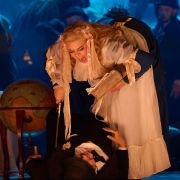
Every seven years, Philipp Stölzl’s inspired production of Der fliegende Holländer drops anchor at a new opera house, hoping to find an audience that will love it unconditionally. At least, that’s how it feels. The Bavarian director’s staging first docked at Theater Basel in 2009 before seeking berths at the Staatsoper Berlin (2013) and the Liceu, Barcelona (2017). Revived by Philipp M Krenn, it now moors at Theater an der Wien where, judging by the ecstatic first night reaction, the Viennese have bestowed redemption.

Stölzl updates the action to the time of composition, setting it the library of a wealthy Victorian gentleman. The panelled back wall is dominated by a huge picture frame featuring a tempestuous seascape. The staging focuses on Senta, first seen during the stormy overture as a traumatised child escaping the predatory behaviour of her bewhiskered father (Wilhelm Schwinghammer) and a disciplinarian Mary (Ieva Prudnikovaite), finding refuge in a giant tome that tells the Dutchman’s tale.
This solace turns into teenage infatuation, what would have been dismissed in Victorian society as “over-stimulation”, as she longs for the Dutchman to appear and save her from the fate of being married off to her father’s choice of bridegroom. The young Senta (Lina Lottes) remains on stage during the first act, buried in an armchair, as the painting opens up and Daland’s ship appears, its hearty crew in sou’westers leaping out of the canvas. The appearance of the Dutchman’s ghostly ship is terrific, its prow jutting through the frame amid a dramatic swirl of dry ice.

Jordan Shanahan’s Dutchman makes a surreptitious entrance, appearing slumped in the same armchair where, until moments before, Senta’s father had been sitting, as if Stölzl is blurring the Dutchman as a father figure in Senta’s troubled mind. He has a hook for a right hand, which he uses to pierce the library’s globe as he bemoans his endless voyage, condemned to sail the seven seas in search of a loving wife. His zombie crew look like refugees from the Pirates of the Caribbean.

In Act 2, young Senta switches with soprano Ambur Braid, in a blue frock and long blonde wig, resembling Lewis Carroll’s Alice, with the female chorus as housemaids. Stölzl throws a curveball when Daland turns up with Senta’s prospective husband: it’s not the Dutchman! Instead, an old guy in tweeds, puffing on a cigar, is left to ‘woo’ Senta, who instead retreats into her fantasy. Here the canvas opens up once again to reveal – in a masterstroke – a replica library in which young Senta appears with the Dutchman, so their duet plays out in parallel, Lottes mirroring Braid’s actions. When a second picture frame opens to reveal a third library – this time featuring a starfield with the furniture floating in space – we really are through Alice’s looking glass.

Act 3’s chorus becomes a wedding party. Senta hits the bottle hard while the guests make merry, ripping pages from her book. The zombie pirates see them off in a slo-mo battle. While Cameron Becker’s Erik pleads with Senta to see reason, the canvas reveals the prow of the Dutchman’s ship, where his ghostly former lovers appear from below deck. She slashes her wrist and neck, sacrificing herself to save the Dutchman, who sails off with young Senta.
MusikTheater an der Wien has assembled a fabulous cast, led by Braid’s magnetic Senta. She is a remarkable stage animal, completely inhabiting the role. She dispatched her ballad with girlish glee, never forcing her gleaming soprano – there’s no need in this 1100-seat theatre – but still comfortably riding the Wiener Symphoniker in the pit. She showed marvellous disdain in her towering confrontation with Becker’s lyrical Erik, while her sozzled Senta wielded a cutlass with relish.

Shanahan is a proper Heldenbariton and his Dutchman was terrifically sung, dark and brooding, his voice filling the house, even from the second stage within a stage. Schwinghammer boomed effectively as Daland, his bel canto duet with Shanahan demonstrating Wagner’s debt to Donizetti and Bellini. Promising tenor James Ley made a powerful impression as the Steersman, with Prudnikovaite rasping severely as Mary. As ever, the Arnold Schoenberg Choir fully entered into the spirit of things, their lusty carousing in Act 3 a triumph. Only the singing of the Dutchman’s off-stage (miked?) ghostly crew disappointed, sounding woefully underpowered, even though 16 singers were listed.

Robert Jindra navigated an assured course through Wagner’s storm-tossed score, with only an errant horn occasionally blotting its pages. This was quite the most thrilling Dutchman I’ve ever experienced. Let’s hope there’s not another seven year wait for it to come ashore once again.