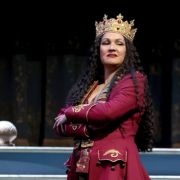
For his final new production as artistic director at the Teatro alla Scala, Riccardo Chailly has chosen Nabucodonosor, the work that marked the true beginning of Giuseppe Verdi’s extraordinary career. The audience’s reaction to this momentous occasion was exceptional. From the moment he first appeared in the pit, the applause was immense and heartfelt. During a scene change, a loud “Bravo Maestro!” from the gallery sparked an ovation that enveloped conductor and orchestra in a warm and affectionate embrace.

Chailly led the La Scala Orchestra in a highly detailed performance: vigorous, at times passionate, yet always attentive to orchestral colour, avoiding the cheap effects the score can occasionally lend itself to. Everything was shaped with elegance and refinement. His attention to the stage was exemplary, carefully supporting the singers whenever they risked being overwhelmed by a fortissimo passage, guiding them with a firm and experienced hand. The La Scala Chorus delivered a magnificent performance, their dynamics sophisticated and their musicality astonishing. After “Va’ pensiero”, the applause lasted nearly five minutes, with repeated calls for an encore, which Chailly declined to grant.

The cast rose fully to the occasion. Anna Netrebko sang the excruciatingly difficult role of Abigaille, bringing every necessary vocal and dramatic resource to the part. Her supple, velvety soprano showed hardly any signs of wear. The lower register was deep and resonant, seamlessly connected to the rest of the voice: her opening phrase, “Prode guerrier”, was perfectly projected, full of menace and sneering authority. In her great scene “Ben io t’invenni, o fatal scritto!”, Netrebko threw herself into the role with the abandon for which she is renowned. The aria “Anch’io dischiuso un giorno” was perhaps her finest moment of the evening, her pianissimi beautifully supported, her timbre lush and velvety, with a fresh and captivating hue. When she launched into the cabaletta “Salirò del trono aurato”, the upper register became brilliant and gleaming, carrying precisely the right metallic edge: an overwhelming effect. Yes, at times the highest notes suggested some effort, and she avoided the concluding high C of the cabaletta, but such details pale beside the sheer magnificence of her performance.
Luca Salsi brought nobility and charisma to the Assyrian king Nabucodonosor: imposing and intimidating when proclaiming himself a god, measured and musically respectful in the mad scene, deeply moving in his conversion to the God of Israel. His “Dio di Giuda” was profoundly felt. Salsi once again demonstrated his instinctive affinity with Verdi’s style; he seems to channel the composer effortlessly, even in roles such as this one, perhaps not entirely suited to the smooth lyricism of his baritone.

Zaccaria was sung by Michele Pertusi, a voice that seems to defy time itself. His opening was not entirely settled, the voice occasionally unsteady, but he quickly took command of the role and delivered a highly convincing performance. His bass was firmly supported and well projected, upper notes beautifully sustained and the lower register secure. His delivery was consistently stylish, Zaccaria’s authority radiating through every phrase. Francesco Meli as Ismaele and Veronica Simeoni as Fenena approached their comparatively small roles with real commitment and excellent chemistry, contributing significantly to the success of the evening.

Director Alessandro Talevi presents a production closely aligned both with the libretto and with Chailly’s detailed, elegant musical approach. The Hebrews are dressed in beige and grey rags (costumes by Gary McCann), while the Assyrian soldiers wear outfits recalling the late 18th century; the women of the court appears in gowns with oriental accents. The central idea, admittedly not the most original, is that every era produces rulers intoxicated by power who come to believe themselves divine. The Hebrews are frequently shown beneath the embrace of the temple, resembling the dome of Rome’s Pantheon: shattered in the opening scene after the Assyrian attack, later transformed into an almost spiritual vision, then finally restored to its former glory.
Many memorable images grace the stage: Nabucco’s entrance on a gigantic chariot drawn by skeletal horses; the Assyrian tower spiralling upward from beneath the stage floor; Nabucco’s feverish dream during the mad scene, in which he walks precariously along a rope while an enormous bird symbolising Abigaille threatens him, finally causing him to fall; Abigaille’s death, struck by lightning and consumed by flames on stage.

The production also includes the ballets Verdi composed for the Brussels performance of 1848, presented here in their first modern staging. The music proves highly interesting and often beautiful, especially in the first divertissement, which features an enchanting cello solo. Talevi imagines a theatre within the Babylonian court, where a play, or ballet, entitled Semiramide is performed, with Abigaille herself as the ancient Babylonian queen. Netrebko – playing a queen portraying a queen – appeared entirely at home with the concept.