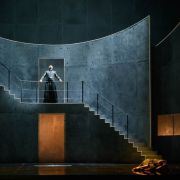
This was a sensational first night at the Opéra National du Capitole de Toulouse. The new production of Richard Strauss’ Salome, which runs until the end of May, will stand as both a successful directing debut for Matthias Goerne and something of a landmark. The German baritone was well qualified for his duties: he knows the opera from the inside, having frequently sung the role of Jochanaan.

The timelessly symbolic set by Hernan Penuela comprises elegant curving grey panels beneath a grand staircase, all framed by a huge gilded shell that opens and closes around the playing space. The further touches of gold on the sober black costumes worn by Herodes and Herodias suggest both the opulence of the tetrarch’s Judean court and the spirit of the Viennese Secession in the years around 1905, when Salome received its premiere.
Among the production’s most memorable moments was the slow emergence from beneath the stage of Jochanaan, encased in a transparent pod and dressed in a dazzlingly white toga that contrasted to stunning effect with Salome’s ochre-toned costume. When it came to the Dance of the Seven Veils, Goerne’s staging was both fascinating and disturbing. In the course of Salome’s erotic dance, as conceived by Oscar Wilde and Strauss, she comes to achieve dominance over Herodes, who, surrendering to lust, is ready to give her whatever she desires. Here, however, in a scene choreographed by Beate Vollack, the Tetrarch reasserted control by submitting his stepdaughter to group rape by seven of his soldiers. The roles in the power game are reversed: Salome is no longer a predatory nymphomaniac but the victim of brutal patriarchy in the form of Herodes and his personal guards. In an isolated gesture of humanity, one of the soldiers tries to protect the princess and covers her up with his coat at the end of the gruelling scene.

Another striking innovation comes in the final scene. Salome does not receive the severed head of Jochanaan on a silver charger from the hands of the executioner; instead the Jews bring her his entire body. His arms are stretched wide, evoking images of the deposition of Jesus from the Cross.
The audience was overwhelmed by Nicole Chevalier as Salome. She had been called in as a replacement just a few days before the first night, following the withdrawal, for personal reasons, of Marie-Adeline Henry. Amazingly, the American soprano, who has a busy international schedule, familiarised herself with the production in just a few hours – and without the benefit of participating in the dress rehearsal. She had made her debut as Salome in Berlin in 2025 and came to Toulouse directly from Basel, where she had been singing La traviata the night before.

From the moment Chevalier made her entrance, her status as a great Salome was assured. Her voice has the timbre, range, ease and endurance that are a prerequisite for the role – one of the most demanding in the repertoire. A real stage animal, she was searingly intense in her confrontation with Jochanaan and her commitment to the drama was evident at every moment, including the orchestral interludes, and she reached expressionistic heights in the final scene – incandescent and seismic in its impact.
Chevalier met her match in Jérôme Boutillier, who made an unqualified success of his debut as Jochanaan with his glowing timbre, strong projection and faultless musicality. If there were moments of vulnerability in his hieratic demeanour, he remained implacable in the face of Salome’s heated entreaties. As Herodes, Nikolai Schukoff produced gleaming, penetrating top notes while portraying the Tetrarch in all his vice and decadence. Herodias is a challenging role, not least for its wide vocal range, but Sophie Koch rose to every demand. Fabien Hyon’s vocal performance as Narraboth was similarly impressive and the numerous supporting roles could not have been better filled.

The woodwinds were first among equals in the Orchestre du Capitole, which combined musicality and precision with colour and sensuality under the baton of Frank Beermann, a Straussian of the first order. The players’ relationship with the seasoned German conductor continues to develop and grow. Occasionally their fervour produced such luxuriant sonorities that the voices were covered, but there could be no doubt that, with this superlative line-up, Strauss’s provocative masterpiece proved as gripping as ever.
Translated into English by Yehuda Shapiro