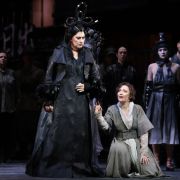
The Teatro alla Scala has revived Davide Livermore’s staging of Turandot, which first appeared in 2024 on the centenary of Giacomo Puccini’s death and is now staged by Laura Galmarini. This revival also marks another centenary: the opera’s premiere, which took place on 25th April 1926, right here in Milan.

The title role is notoriously treacherous and exhausting; this revival rested firmly on Anna Pirozzi, who has sung the part in nearly every major international opera house. She dominated the performance with absolute confidence, impressive technique and high notes forged from diamonds and steel, cutting through the strongest orchestral fortissimos in one of Europe’s largest theatres. All this came with great musical intelligence and nuanced dynamics – her voice shifting from the shimmering ice of “In questa reggia” to tender abandon in the final duet. She delivered beautiful pianissimos and a constant, text-driven intensity. She sneered during the riddles scene (“Sei pallido, straniero”), while her surprise at Liù’s sacrificial love felt genuine, as if she truly didn’t understand. She fully owned the role.

Calaf, the “unknown prince” who finally wins over Turandot, is portrayed as a rash, impulsive young man driven by passion that becomes obsession, willing to sacrifice everything. The score describes this with brazen, leaping phrases and several exposed high notes. Roberto Alagna, after a spectacular four-decade career, seemed somewhat out of his depth in this fiendish role, where experience and know-how only go so far. Naturally, his voice no longer has its former freshness; projection was sometimes insufficient, and some high notes were more attempted than sung (like the high C in “Ti voglio tutta ardente d’amore!”). Still, his phrasing was elegant and charming, and he nailed “Nessun dorma” (high B included), earning applause that stopped the show.
Liù, the slave girl in love with Calaf, was Mariangela Sicilia, whose soprano had a dramatic vein and powerful, metallic quality, yet could still make time stand still with ravishing pianissimi. Her breath control was superb, as shown in the legato between “Ei perderà suo figlio” and “io l’ombra d’un sorriso”. Livermore seems to favour this poor girl, who ends up taking her own life to save Calaf: the staging presents her as the only truly human character. Her success was tremendous.

Timur, Calaf’s father, was Riccardo Zanellato, who interpreted the old, deposed king with great nobility and splendid stage presence. His bass was smooth and stylish, and his intervention after Liù’s death was deeply moving. The three Imperial Officials – Ping, Pong and Pang, who provide comic relief – were admirably played by Biagio Pizzuti, Paolo Antognetti and Francesco Pittari; their timing and chemistry were absolutely perfect. Pizzuti, in particular, impressed with a smooth, well-projected baritone. Alberto Petricca was a remarkable Mandarin, his baritone powerful and well projected, as a herald should be.
Nicola Luisotti conducted the La Scala orchestra in a grandiose, almost ceremonial reading of the score. He favoured a romantic interpretation of Puccini’s music, downplaying its more modern aspects. This approach was nonetheless very successful, yielding a luxurious sound. His handling of “Tu, che di gel sei cinta”, Liù’s final aria, was heartbreaking, with woodwinds following Sicilia’s mournful tone in a sort of lullaby accompanying her to her death. The La Scala chorus gave its usual spectacular performance, with a particularly transparent and inspired invocation to the Moon.

This revival confirms the positive impression from the production’s first appearance. It is visually enchanting, technically complex and always aligned with the music and its intent. The company D-WOK created a new world with its videos – much more than simple projections on flat surfaces. A large, round frame is often lowered mid-stage, rendered three-dimensional by the videos, showing trees, flower petals and often the moon’s surface, particularly evocative this week following the successful conclusion of NASA’s Artemis mission and all the beautiful new moon photos on social media.
The staging is very busy, with constant activity on stage, but every movement of singers, mimes and chorus is meticulously planned and well coordinated. An actress plays Princess Lo-u-Ling, Turandot’s ancestor who was raped and killed by the prince of an invading army – the crime Turandot seeks to avenge by executing all princes who court her. Turandot constantly mirrors her movements and expression: perhaps a corny device, but effective in expressing the princess’s obsession with being ‘possessed’ by her ancestor’s soul.